Technical Introduction: Defining M365 License Optimization
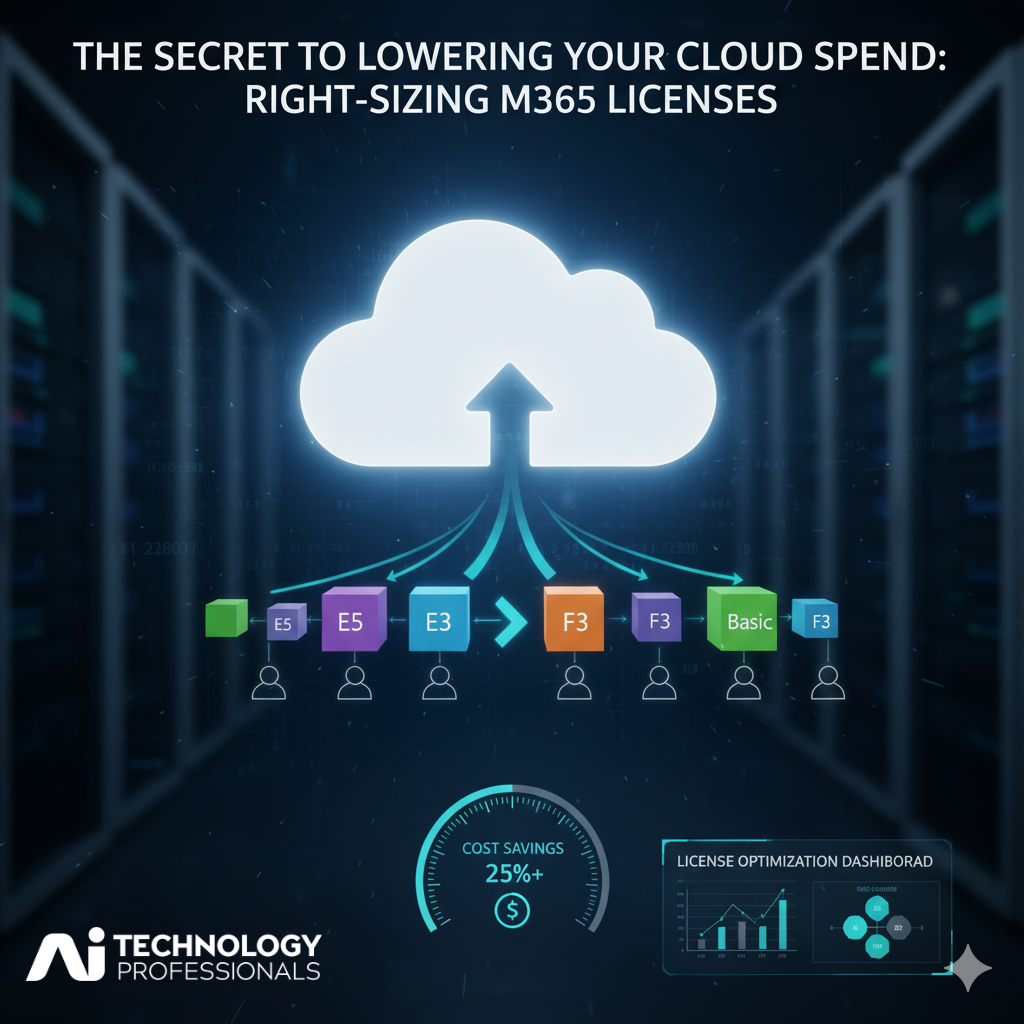
Microsoft 365 (M365) subscription management, often viewed solely as a financial task, is fundamentally a technical governance challenge. The proliferation of various licensing tiers—from E5 to Business Basic—creates an environment ripe for expenditure waste and compliance risk if not meticulously governed. License right-sizing is the proactive and continuous process of aligning the features and services available within an allocated M365 license to the precise technical requirements and usage patterns of the end-user or workload.
This technical guide addresses the scope of this challenge, providing a structured, authoritative framework for IT Directors and Procurement Managers to implement robust license governance that maximizes ROI and minimizes security exposure from under- or over-provisioning.
The Technical Challenge of M365 License Governance
The complexity of M365 license management stems from several technical and operational pitfalls that lead to budget bloat.
- Feature Creep and Over-Provisioning: Assigning premium licenses (e.g., E5 or E3) to users who only require basic functionality (e.g., F3 or Business Basic), resulting in payment for unused security and compliance features.
- The “Orphaned” License Problem: Licenses remaining assigned to accounts of departed employees due to delayed or incomplete off-boarding procedures in Azure AD/Exchange Online.
- Dynamic Usage Patterns: The static assignment of licenses that fails to adapt to departmental shifts, project-based roles, or seasonal workforce changes, leading to temporary over-licensing.
- Compliance and Security Gaps (Under-Provisioning): Conversely, assigning a lower-tier license to a user whose role demands advanced security or compliance features (e.g., litigation hold, DLP), creating regulatory non-compliance risk.
- Decentralized Shadow IT Purchases: Departments procuring add-on services or licenses outside of a central IT procurement process, fragmenting management and increasing audit risk.
Core Principles of M365 License Governance
Effective license governance is predicated on establishing clear policies and leveraging technical audit data.
- Principle of Least Privilege Licensing (PLL): Users and workloads must be assigned the minimum necessary license tier that provides the specific functional, security, and compliance features required for their role and data access.
- Continuous Audit and Remediation Cycle: License status and usage must be audited quarterly (at minimum) using tools like Microsoft 365 usage reports, PowerShell scripts, or third-party license management solutions.
- Role-Based Access Control (RBAC) Integration: Licenses should be tied to Azure AD security groups, and assignments should follow a strict RBAC policy. This automates the de-provisioning process upon role change or departure.
- Policy-Driven De-provisioning: A strict Service Level Agreement (SLA) must be defined for the removal and reclamation of licenses following employee termination or extended leave (e.g., within 48 hours of departure).
Three Critical Implementation Phases for Right-Sizing
The technical execution of license right-sizing must follow a structured, three-phase approach, prioritizing data over assumptions.
1. Technical Data Acquisition and Baseline Audit
The first phase involves collecting precise, objective data on current license assignments and usage to establish a baseline.
- Usage Analysis: Execute PowerShell cmdlets (e.g., Get-MsolUser combined with Exchange and SharePoint usage logs) to identify last login dates, service consumption (e.g., mailbox size, OneDrive usage), and utilization of advanced features (e.g., Power BI Pro, Advanced Threat Protection).
- Feature Mapping: Create a matrix that maps specific organizational roles (e.g., “Field Sales,” “Executive,” “Warehouse Staff”) to the absolute minimum required M365 license tier based on feature sets. For instance, if a user primarily uses Outlook Web Access and Teams Chat, a Business Basic or F3 license may suffice, eliminating the need for Business Standard or E3.
- Orphaned Account Identification: Query Azure AD for accounts that are enabled and licensed but have been inactive for more than 30-90 days, flagging them for immediate license reclamation.
2. Policy Formulation and Automated Assignment
Based on the audit, IT must codify the new licensing policy and automate its enforcement.
- Group-Based Licensing (GBL): Implement Azure AD Group-Based Licensing to assign licenses to security groups rather than individual users. This ensures license assignment and removal is directly linked to the user’s membership, which is generally updated during the standard HR on-boarding/off-boarding process.
- Governance Thresholds: Establish an official policy that dictates the maximum acceptable cost of unused licenses. For example, “Any license tier with less than 10% usage of its premium features for two consecutive quarters will be immediately flagged for downgrade.”
- Workflow Integration: Integrate license changes into existing IT Service Management (ITSM) workflows. A request for a higher-tier license must be treated as a security/access request, requiring mandatory technical justification and approval from both the IT Director and Financial Manager.
3. Change Management and Continuous Monitoring
The process concludes with communication and the establishment of a cyclical review process to ensure the right-sizing remains effective.
- User Communication: Proactively inform users about the changes, especially if a downgrade results in the loss of a non-essential feature. Provide a clear path (e.g., an IT ticket) for users to technically justify the need for a higher-tier license.
- Quarterly Review: Conduct a recurring audit before the annual or monthly subscription renewal date. Use this opportunity to challenge the status quo, re-evaluate user roles against current licenses, and execute the final license quantity adjustment.
- Security Posture Validation: After any license downgrade, validate the security posture of the affected users. Confirm that the new, lower-tier license still meets baseline security requirements (e.g., Multi-Factor Authentication enforcement, basic malware protection).
Impact of Strategic M365 Management
Implementing rigorous M365 license right-sizing governance delivers measurable and strategic benefits that extend beyond simple cost reduction.
- Quantifiable Cost Savings: The direct benefit is a measurable reduction in monthly recurring expenditure by eliminating unnecessary premium licenses and reclaiming unused slots. Savings of 15-25% are common in environments without prior governance.
- Enhanced Security Posture: By enforcing the Principle of Least Privilege Licensing, IT reduces the attack surface. Over-provisioned accounts often have unused access to advanced features that could be exploited.
- Streamlined Compliance: A clear, documented licensing policy simplifies audit readiness. It provides clear evidence that the organization is adhering to vendor licensing agreements and regulatory requirements concerning data security features (e.g., E5 features for compliance-heavy roles).

Conclusion: Governance as a Cost-Saving Strategy
The secret to lowering cloud spend is not a one-time adjustment but the implementation of continuous, technical governance. For IT professionals, M365 license right-sizing is a critical discipline that shifts management from a passive, reactive expense to a proactive, cost-saving strategic asset. By prioritizing data acquisition, automated policy enforcement, and the Principle of Least Privilege Licensing, organizations can ensure their cloud investment is Human-Driven, AI-Powered, and perfectly aligned with their technical requirements.