Executive Summary
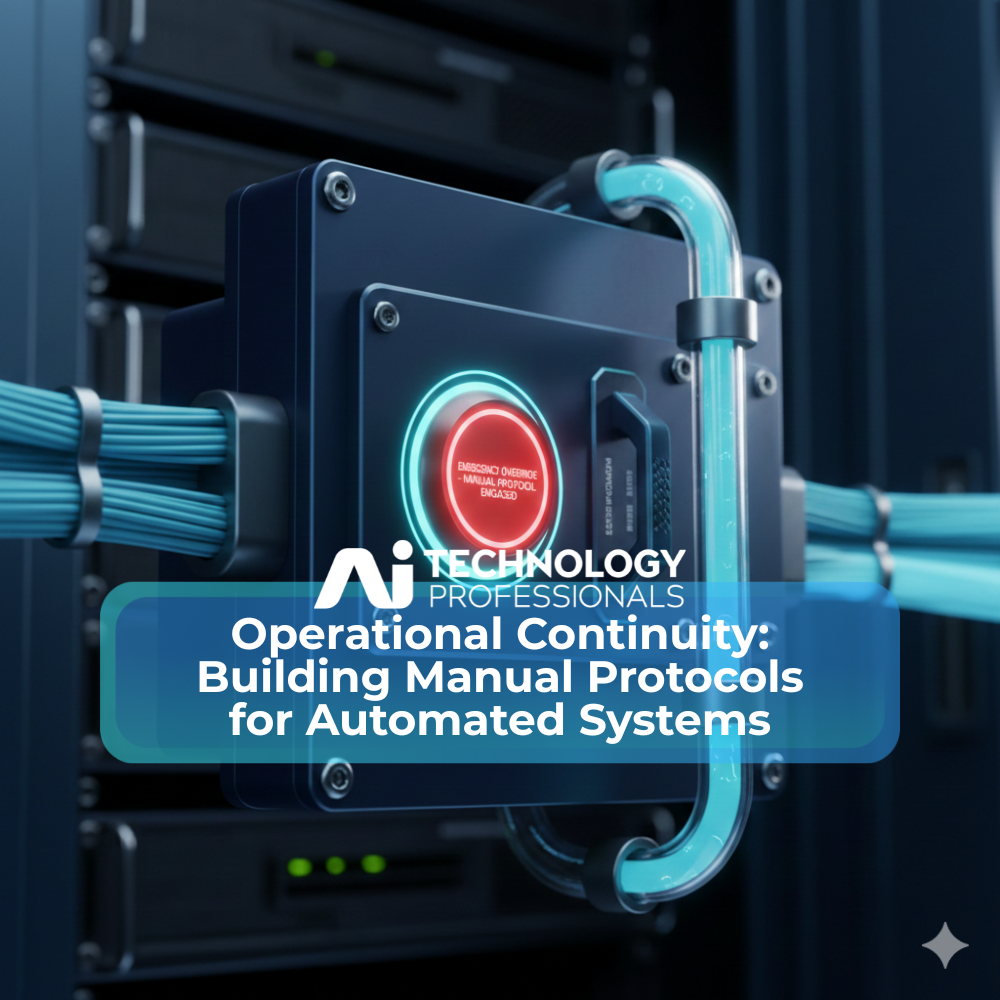
As enterprise environments achieve unprecedented levels of automation, the hidden risk of “automation complacency” creates a single point of failure during catastrophic systemic outages. This strategic briefing outlines how to architect manual fallback protocols that preserve operational integrity when the digital orchestration layer fails.
Key Takeaways
- The Paradox of Automation: Increasing system sophistication often degrades the human ability to intervene, necessitating a “decoupled” manual strategy.
- Defining the Minimum Viable Operation (MVO): Strategy must shift from full restoration to maintaining the critical path through analog or low-tech alternatives.
- Validation through “Degraded State” Testing: Resilience is not a theoretical attribute; it must be verified through controlled, systematic disconnection of automated dependencies.
The Fragility of the Modern Tech Stack
In the pursuit of efficiency, modern enterprises have engineered environments where processes are so deeply intertwined with automated logic that the “human-in-the-loop” has been effectively removed. While this drives record-breaking throughput and sub-millisecond response times, it introduces a profound strategic vulnerability. When the automation layer—be it a CI/CD pipeline, an ERP orchestration engine, or an AI-driven logistics router—suffers a Tier-0 failure, the organization often finds itself paralyzed.
The risk is no longer just “downtime” in the traditional sense. It is the loss of institutional knowledge regarding how the business actually functions beneath the software. If your team cannot process an order, move a pallet, or authenticate a user without a specific cloud service, you do not have a resilient business; you have a brittle one. Operational Risk Management must now account for the “Black Swan” event where the automation itself becomes the adversary.
Architecting the Manual Fallback Framework
Building manual protocols is not a regressive step; it is a sophisticated form of insurance. It requires a granular understanding of your technical dependencies and the courage to ask: “If this button stops working, who picks up the pen?”
Defining the Minimum Viable Operation (MVO)
The first step in narrative architecture for continuity is identifying the MVO. This is not a mirrored version of your digital environment. Instead, it is the absolute baseline of activity required to prevent total business collapse or regulatory non-compliance.
- Critical Path Identification: Map the revenue-generating or life-safety workflows that must persist regardless of system availability.
- Data Decoupling: Identify the “Source of Truth” and ensure that essential data (e.g., customer manifests, inventory counts, cryptographic keys) is accessible in a format that does not require the primary application to read.
- Human Resource Mapping: Identify the “Legacy Experts”—individuals who understand the underlying logic of the process before it was automated.
The Role of Immutability and Air-Gapping in Manual Recovery
In a ransomware scenario, your automated backups may be compromised or encrypted. Manual protocols must rely on “Air-Gapped” or immutable data stores. Strategically, this means maintaining a physical or logically isolated “Break Glass” repository. This repository should contain the “Runbooks for the Ruined”—step-by-step, non-digital instructions that guide staff through manual data entry, physical verification, and offline communication.
Strategic Implementation of Manual Protocols
Once the MVO is defined, the organization must transition from theory to tactical readiness. This involves shifting the culture from “digital-only” to “digital-first, manual-ready.”
Developing “Offline” Runbooks
A technical manual is useless if it requires a Wiki login to access during a network blackout. High-authority continuity plans require physical or local-cached copies of operational procedures. These runbooks must be:
- Atomic: Each instruction should be a single, non-ambiguous action.
- Role-Based: Written for the person on the floor, not the architect who designed the system.
- Updated Synchronously: Every time the automated software is updated, the manual fallback must be reviewed for drift.

RPO and RTO in a Manual Context
Recovery Point Objectives (RPO) and Recovery Time Objectives (RTO) are standard metrics for system restoration, but they are rarely applied to manual shifts. Leaders must define how much data can be “lost” or delayed when switching to paper-based or spreadsheet-based tracking.
For instance, if the RTO for an automated shipping system is 4 hours, but the manual workaround takes 12 hours to initialize, there is an 8-hour “Resilience Gap.” Closing this gap requires pre-staged physical assets, such as pre-printed forms or offline-capable handheld devices that can sync via local serial connections once the network returns.
Validating Resilience Through Degraded State Testing
The most common failure in Operational Risk Management is the “Shelfware” syndrome—plans that are written, audited, and then forgotten. To ensure manual protocols are viable, they must be tested under duress.
The “Kill Switch” Exercise
Elite IT organizations conduct “Degraded State” testing. This is not a standard DR drill where you fail over to a hot site. Instead, it involves intentionally disabling a key automation component and requiring the business unit to operate using only their manual runbooks for a set period.
- Observability of Friction: During these tests, leadership should look for where the manual process breaks down. Is it a lack of physical supplies? Is it a loss of “muscle memory” among staff?
- Iterative Refinement: Use the friction points found during testing to refine the runbooks. The goal is to reduce the “cognitive load” on employees who are already under stress during a real outage.
Training for the “Analog Pivot”
As younger cohorts enter the workforce, many have never operated in a non-digital environment. Training programs must include “Analog PIVOT” sessions. These sessions ensure that staff are comfortable with the manual tools of their trade, whether that is manual ledger entry, radio-based communication protocols, or physical inventory counting.
Addressing the Economic Justification
C-Suite executives often view manual protocols as an unnecessary expense—a “redundancy of a redundancy.” However, the cost of total paralysis far outweighs the cost of maintaining manual readiness.
The strategic value of manual protocols lies in “Time to Integrity.” While your competitors are waiting for their SaaS providers to restore service or for their encrypted databases to be scrubbed, a manual-ready organization continues to move, albeit at a slower pace. This maintains customer trust, fulfills contractual obligations, and provides a psychological “anchor” for the workforce, preventing the panic that often accompanies systemic failure.
Conclusion
The mark of a mature enterprise is not the complexity of its automation, but the resilience of its foundations. By decoupling essential business logic from the software layer and codifying manual fallback protocols, IT leaders move beyond simple disaster recovery into the realm of true operational continuity. In an era of increasing cyber volatility, the ability to “go manual” is not a sign of technical weakness—it is the ultimate strategic safeguard.
Frequently Asked Questions (FAQs)
What is a Minimum Viable Operation (MVO)?
An MVO is the absolute baseline of manual processes required to prevent business collapse during total system failure. It prioritizes the critical path over full-featured digital restoration to maintain regulatory and contractual integrity.
How do manual protocols improve RTO?
Manual protocols reduce the “Resilience Gap” by providing immediate, non-digital instructions for core workflows. Pre-staged physical runbooks ensure personnel can pivot to analog operations while technical teams work on backend restoration.
Why is automation a risk to institutional knowledge?
Deep automation creates a “human-out-of-the-loop” environment where staff lose the ability to perform tasks without software guidance. Maintaining manual protocols forces the retention of underlying business logic and operational expertise.
What is “Degraded State” testing?
It is a controlled exercise where an automation layer is disabled to force the use of manual fallback procedures. This validates the accuracy of offline runbooks and identifies friction points in a low-stakes environment.
How should manual runbooks be stored?
Runbooks must be stored in immutable, air-gapped formats that do not rely on the primary network for access. This includes local cached copies on isolated hardware or physical binders to bypass network-wide ransomware or outages.