EXECUTIVE SUMMARY
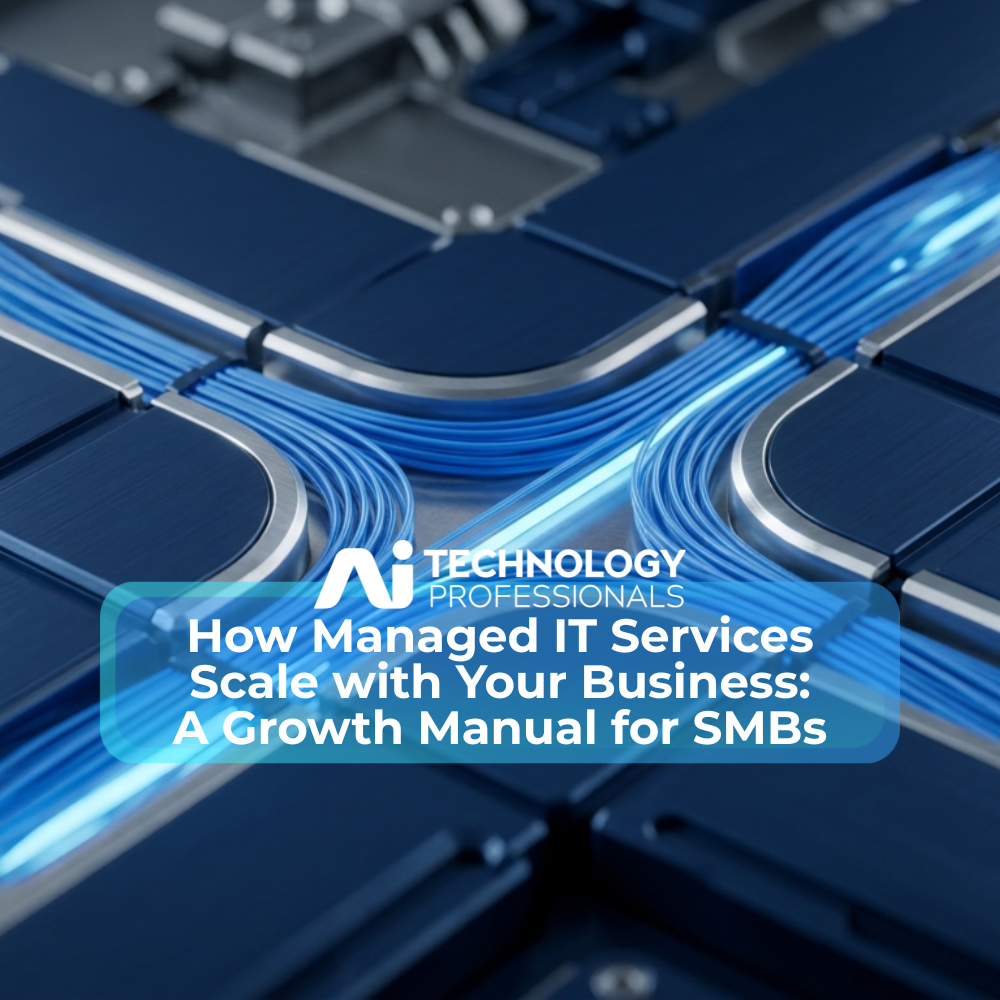
Modern enterprise growth is no longer limited by physical overhead but by the elasticity of the underlying technical stack. This manual delineates how transitioning from reactive maintenance to a Managed Service Provider (MSP) model secures the operational continuity and rapid resource deployment required for mid-market dominance.
KEY TAKEAWAYS
- Decoupling Growth from Headcount: Leveraging external expertise allows for sub-linear scaling, where revenue increases without a corresponding 1:1 spike in internal IT payroll.
- Hardening the Risk Profile: Shifting to a proactive security posture ensures that expansion does not inadvertently broaden the attack surface or compromise regulatory compliance.
- Operational Predictability: Converting erratic capital expenditures (CapEx) into stable operating expenses (OpEx) provides the fiscal clarity necessary for aggressive long-term planning.
The Fallacy of the “Break-Fix” Paradigm in Growth Phases
For the SMB on the cusp of enterprise status, the “break-fix” mentality is a strategic liability. In a nascent stage, a business may survive on a reactive model—fixing hardware only when it fails. However, as the organization scales, the cost of downtime scales exponentially. When a single hour of system unavailability impacts hundreds of employees and thousands of customer touchpoints, the “fix-it-later” approach results in catastrophic revenue leakage.
Managed IT services replace this fragility with Immutability and Redundancy. By integrating automated monitoring and management, the enterprise shifts from a defensive “waiting for failure” stance to an offensive “optimized performance” stance. This transition is critical for maintaining high availability in an environment where the Recovery Time Objective (RTO) must approach near-zero to remain competitive.
Engineering an Elastic Infrastructure
The primary challenge of business growth is the unpredictable nature of resource demand. Traditional internal IT departments often struggle with the “Lead Time Gap”—the weeks or months required to procure, configure, and deploy new hardware or software licenses. Managed services eliminate this friction through Cloud Orchestration and Virtualization.
Fluid Resource Allocation
A sophisticated MSP partner provides the framework for “Just-in-Time” infrastructure. Whether the enterprise is onboarding fifty new employees or launching a data-intensive product line, the infrastructure must expand elastically. This is achieved through Software-Defined Networking (SDN) and automated provisioning, ensuring that the technology stays ahead of the business requirements rather than acting as a bottleneck.
Strategic Technical Debt Mitigation
Rapid growth often leaves a trail of “technical debt”—hastily implemented solutions that lack long-term viability. Managed IT architects act as the “Narrative Architects” for the firm’s digital future, ensuring that every new integration follows NIST Digital Identity Guidelines and standardized protocols. This prevents the “spaghetti code” infrastructure that often hobbles late-stage SMBs.
The Security Imperative: Zero-Trust and Sovereign Data
As an organization grows, it becomes a more attractive target for sophisticated threat actors. The “moat and castle” security philosophy—relying solely on a perimeter firewall—is obsolete in an era of remote work and decentralized data. A Managed IT strategy adopts a Zero-Trust Architecture, where every access request is verified, regardless of its origin.
Air-Gapping and Immutable Backups
To protect the enterprise’s most valuable asset—its data—Managed IT services implement rigorous backup regimes. This includes the use of “Air-Gapping,” where a copy of the data is physically or logically isolated from the primary network to prevent lateral movement of ransomware. Leaders must view these measures not as “IT costs,” but as an insurance policy against existential threats. Detailed strategies for maintaining these defenses can be explored via the CISA Cross-Sector Cybersecurity Performance Goals, which provide a benchmark for organizational resilience.
Compliance as a Competitive Edge
Expansion into new markets often brings the enterprise under the jurisdiction of complex regulatory frameworks (GDPR, HIPAA, SOC2). Managed IT providers specialize in maintaining the “Compliance Posture” of the organization, automating the audit trails and data sovereignty requirements that would otherwise overwhelm an internal team. By turning compliance into a standardized process, the business can enter new markets with confidence and speed.
Optimizing the Human Capital ROI
The most significant drain on a CTO’s budget is the “Commodity Task”—the routine patching, password resets, and server maintenance that consume the bandwidth of high-value engineers. When these tasks are offloaded to a Managed Service Provider, the internal team is liberated to focus on Innovation and Core IP Development.
Specialized Expertise on Demand
No SMB can afford a full-time in-house expert for every niche: cybersecurity, cloud architecture, database administration, and disaster recovery. A managed model provides a “Fractional Expert” approach, giving the enterprise access to a deep bench of specialized talent only when it is needed. This provides the technical sophistication of a Fortune 500 company at a fraction of the cost.
Business Continuity and Disaster Recovery (BCDR)
Scaling a business requires a robust plan for the “unthinkable.” Managed services provide a structured BCDR framework that defines the Recovery Point Objective (RPO)—the maximum age of files that must be recovered from backup storage for normal operations to resume. For deep technical insights into building these resilient systems, executives should reference the OWASP Top 10 Framework, which outlines the critical vulnerabilities that must be addressed during any infrastructure expansion.
Conclusion: The Strategic Pivot to Managed Maturity
The decision to leverage Managed IT services is not merely an outsourcing of labor; it is a strategic pivot toward operational maturity. For the C-Suite and Director-level decision-maker, the value proposition is clear: Managed IT converts the technical stack from a volatile cost center into a stable, scalable engine for growth. By institutionalizing security, ensuring elasticity, and reclaiming internal bandwidth, the enterprise positions itself to navigate the complexities of the modern market with agility and resilience. In the final analysis, the most successful organizations are those that view their IT infrastructure not as a utility to be managed, but as a strategic asset to be mastered.
Frequently Asked Questions (FAQs)
How does managed IT reduce long-term operational costs?
Managed IT shifts unpredictable capital expenditures into a stabilized operating expense model. This prevents emergency repair spikes and allows for sub-linear scaling where revenue outpaces IT headcount growth.
What is the difference between RPO and RTO in a growth context?
RPO defines the maximum tolerable data loss, while RTO measures the duration of system downtime. Optimizing these metrics ensures that enterprise expansion does not result in exponentially expensive service interruptions.
Why is a Zero-Trust model necessary for scaling SMBs?
Zero-Trust eliminates the inherent risk of a traditional perimeter by verifying every access request regardless of location. As an organization adds remote nodes and cloud services, this framework prevents lateral movement by attackers.
Can managed services help with industry-specific compliance?
Yes, managed providers automate audit trails and data sovereignty requirements to meet frameworks like GDPR or SOC2. This allows the enterprise to enter regulated markets rapidly without building compliance teams from scratch.
What is “Technical Debt” and how do MSPs mitigate it?
Technical debt refers to the long-term cost of choosing easy, short-term software or hardware solutions over scalable ones. Managed architects enforce standardized protocols and NIST-aligned frameworks to ensure infrastructure remains modular and sustainable.
Share this post