Executive Summary:
Self-service password reset (SSPR) and service desk reset workflows have become the primary attack vector for modern account takeover (ATO) attacks. Relying on password resets as a substitute for true identity verification exposes organizations to social engineering, helpdesk impersonation, and SIM-swapping compromises. Decoupling identity proofing from the password reset mechanism ensures that an employee’s identity is cryptographically or out-of-band verified before credentials can be rotated.
Key Takeaways:
- Password resets are not authentication: Treating credential rotation as proof of identity creates a fundamental security loop hole.
- Helpdesks are targeted via social engineering: Vishing and AI voice deepfakes routinely trick support staff into resetting MFA and passwords for unauthorized actors.
- Strong identity proofing is required upstream: Organizations must mandate phishing-resistant out-of-band verification—such as FIDO2 tokens, biometric identity verification, or verified enterprise credentials—before triggering a password reset event.
The Broken Trust Model of Modern Credential Management
In most enterprise IT environments, password resets are treated as a routine maintenance task. When an employee forgets their credentials or gets locked out of their account, the goal of the IT helpdesk or self-service portal is speed and resolution. However, this focus on efficiency has inadvertently turned the password reset workflow into the single weakest link in enterprise cyber defense.
Attackers no longer breach networks solely by exploiting unpatched software or cracking complex passwords. Instead, they exploit the human element of credential recovery. By contacting a helpdesk or manipulating automated password reset flows, malicious actors trick systems and support engineers into handing over access to high-privilege accounts.
The underlying problem is a flaw in identity architecture: confusing credential possession with identity verification. Resetting a password does not prove who someone is; it merely changes the secret key attached to an identity. Until organizations separate the process of proofing identity from the mechanics of resetting credentials, account takeover risks will continue to multiply.
Why Traditional Password Resets Fail Security Standards
The vulnerability of modern password reset systems stems from historical design choices that prioritized user convenience over cryptographic trust.
The Self-Service Loophole
Self-service password reset (SSPR) mechanisms frequently rely on static knowledge-based authentication (KBA), such as security questions, or basic secondary channels like SMS and email one-time passwords (OTPs). In an era where employee data is readily available through public breaches, social media, and OSINT (Open-Source Intelligence), KBA offers virtually no security. Furthermore, SMS and email channels are easily intercepted via SIM swapping, phishing sites, or session hijacking.
Social Engineering and Helpdesk Exploitation
When automated SSPR fails, users turn to the internal helpdesk. Cybercriminals exploit the helpful nature of IT support staff through sophisticated voice phishing (vishing), impersonation, and synthetic media. Support engineers are often pressured by attackers posing as stressed executives or remote workers in urgent need of access, leading to unauthorized overrides and reset approvals.
The Misunderstanding of Multi-Factor Authentication (MFA)
Many organizations assume that enforcing MFA during a reset request mitigates risk. However, if an attacker has compromised a primary session or registered a secondary device during an unverified onboarding window, standard MFA prompts simply validate the attacker’s setup rather than the actual employee.
Decoupling Identity Proofing: Architectural Blueprint
To solve this challenge, enterprises must decouple identity proofing from credential management. Identity proofing must operate as an independent, upstream gatekeeper. Decoupling identity means that neither the user nor the helpdesk agent can initiate a password state change without an independent verification signal generated outside of the standard credential ecosystem.
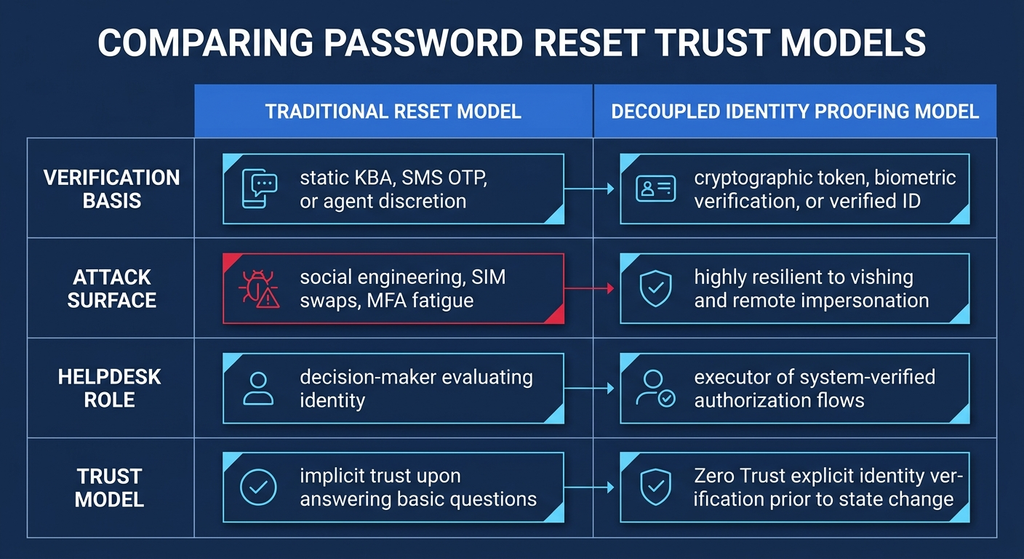
The architecture outlined above transitions identity proofing from an informal conversation into an audited, deterministic security event.
Implementing Strong Upstream Identity Proofing
Transitioning to a decoupled identity model requires adjusting both technical infrastructure and organizational policies.
Deploy Phishing-Resistant Identity Verification
Replace traditional SSPR verification methods with phishing-resistant identity proofing tools. Require users to authenticate their identity using FIDO2 hardware keys, government-issued document verification with live liveness checks, or pre-registered, cryptographically paired mobile devices.
Enforce Modern Identity Governance at the Service Desk
Eliminate support agent discretion in credential reset workflows. Service desk software should require support agents to send a out-of-band push verification to an established trusted device or mandate an automated identity check before the “reset password” button becomes active in the administrative console.
Implement Temporary Revocable Access Protocols
When an employee loses all credentials and devices, avoid permanent credential resets over unverified channels. Instead, issue short-lived, single-use bypass codes tied to an out-of-band video or in-person verification process, enforcing an immediate MFA re-enrollment upon login.
Securing the Enterprise Credential Lifecycle
Decoupling identity proofing from password resets is not simply an IT efficiency project; it is a foundational pillar of modern Zero Trust architecture. By treating every password reset as a high-risk security event that requires explicit, independent identity verification, organizations close one of the most frequently exploited attack vectors used by modern threat actors today.
When convenience is balanced with rigorous identity verification, the helpdesk transforms from a primary target of social engineering into a resilient component of enterprise defense.