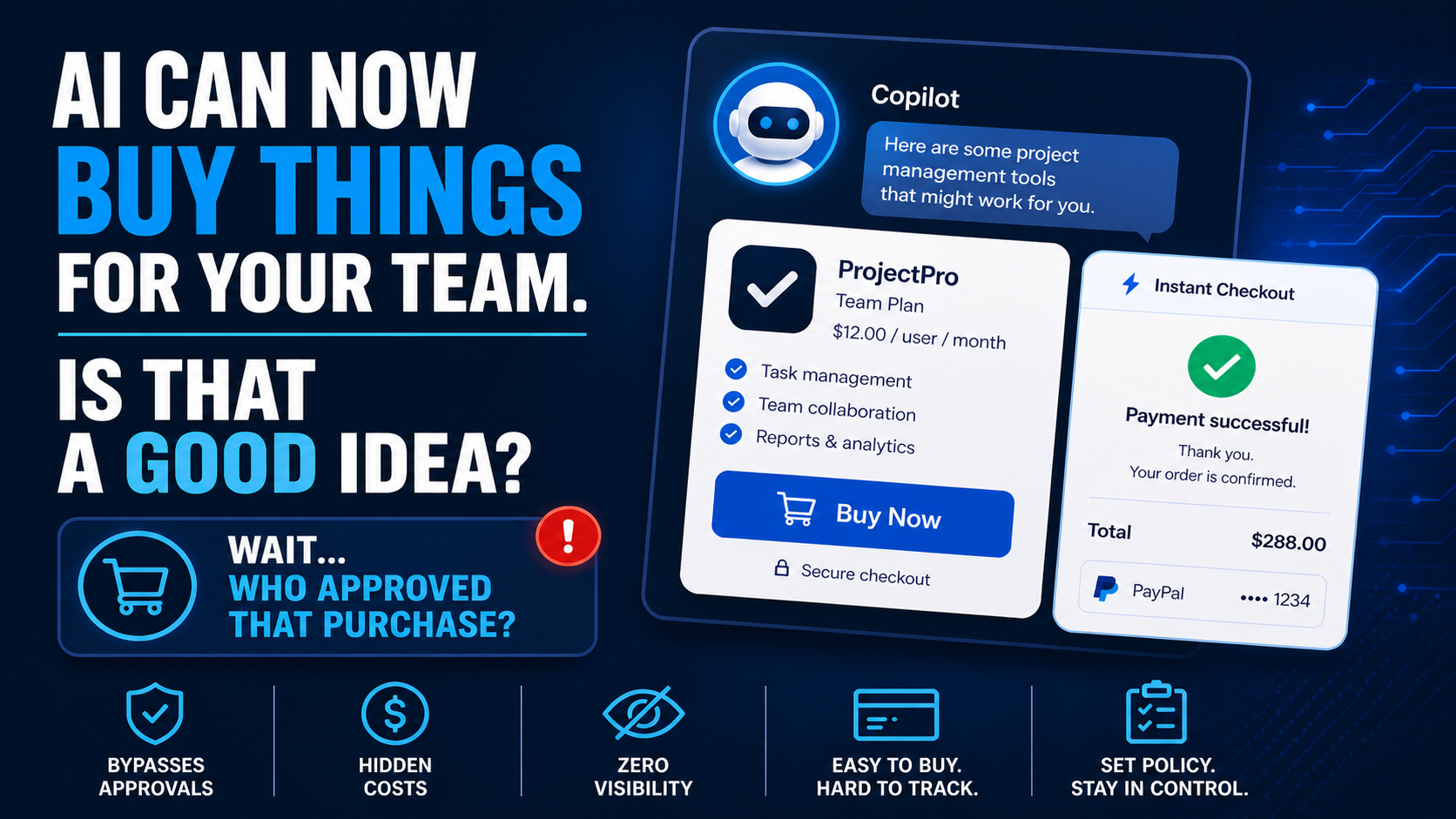

Hook: “Wait… Who Approved That Purchase?”
Here’s something most business owners haven’t run into yet.
An employee asks an AI tool for a recommendation… and then buys it on the spot.
No vendor website. No approval chain. No second thought.
Just click, confirm, done.
Convenient? Absolutely.
But it raises a bigger question.
Are you okay with that?

The Problem: Buying Just Got a Lot Easier to Bypass Controls
Tools like Microsoft Copilot and ChatGPT started out helping with emails, documents, and quick answers.
Now they’re moving into something more practical.
Purchasing.
Features like Instant Checkout and Copilot Checkout let users find products and complete purchases directly inside the AI tool.
No switching tabs. No checkout pages. No pause to think it through.
That sounds efficient until you look at how most businesses actually handle purchasing.
Around Central Virginia, we see this all the time. Businesses intentionally slow things down.
There are approvals. Budget checks. Preferred vendors. A paper trail.
That structure exists for a reason.
When buying becomes frictionless, those guardrails can get skipped without anyone meaning to.
Simple Explanation: What “AI Checkout” Really Means
Let’s break it down in plain terms.
Your employee asks Copilot for a recommendation. Maybe software, equipment, or a subscription.
Copilot suggests options.
If the seller supports checkout inside the platform, the employee can complete the purchase right there.
No external site. No traditional checkout flow.
It’s all handled inside the AI tool, using connected payment systems like PayPal, Stripe, or Shopify.
Here’s the catch.
The easier it is to buy, the less likely someone is to stop and ask, “Should I?”

Real-World Example: How This Plays Out
Let’s say you run a small business in Midlothian.
Someone on your team needs a new project management tool.
They ask Copilot for suggestions.
A few options come up. One looks good. They click “Buy.”
Done.
But now step back for a second.
- Was that tool approved?
- Does it overlap with something you already pay for?
- Did it go on a company card or a personal one?
- Is anyone tracking that subscription?
Nobody did anything wrong.
But now you’ve got extra software, extra cost, and zero visibility.
We’ve seen versions of this happen even without AI. This just makes it faster.
The Solution: Set Expectations Before It Becomes a Problem
This isn’t about blocking new technology.
It’s about deciding how it fits into your business before it creates confusion.
If you’re okay with your team using AI checkout tools, set some clear boundaries:
- Who is allowed to make purchases
- What types of purchases are allowed
- Which payment methods can be used
- Where those purchases are tracked
- What approval (if any) is still required
And just as important, make sure your team understands it.
Convenience doesn’t replace responsibility.
If you’d rather not have this used at all, that’s fine too.
But it needs to be documented, communicated, and enforced.
Because if it’s not clear, people will assume it’s allowed.

Key Takeaways
- AI tools are starting to include built-in purchasing features
- Buying inside chat removes friction and speeds up decisions
- That convenience can bypass normal approval processes
- Without visibility, costs and subscriptions can quietly grow
- Clear policies and communication matter more than ever
CTA: Let’s Make Sure This Doesn’t Catch You Off Guard
AI features like this don’t show up with a big announcement.
They just appear, and people start using them.
If you’re not sure how this fits into your current policies, it’s worth a quick conversation.
We can help you figure out what makes sense for your business, your team, and how you want purchases handled moving forward.
No pressure. Just a practical look at where things stand and what to do next.