Here is the stark reality for modern business leaders: threat actors no longer need to spend days researching your company to launch a convincing attack. By leveraging automated AI tools, cybercriminals can scrape public records, craft personalized high-converting phishing emails, and bypass traditional security filters in seconds—with your finance and accounting teams sitting directly in their crosshairs.
The Executive Summary
The finance office has fast become the most targeted department in the mid-market enterprise.
Historically, Business Email Compromise (BEC) required significant manual effort from an attacker. Today, generative AI and automated threat platforms allow malicious actors to scale hyper-personalized campaigns instantly. These campaigns exploit invoice workflows, vendor changes, and payroll approvals with flawless language and realistic context.
To defend your capital, modern security strategy must shift from relying on employee intuition to deploying automated, behavioral-based defensive controls.
The New Reality in the Back Office
There is a dangerous disconnect occurring inside mid-sized organizations today.
Most executive teams believe their cybersecurity training is working because employees know how to spot classic red flags. We tell our staff to look for poor grammar, awkward phrasing, and suspicious sender domains.
However, modern AI automated tools have rendered those traditional red flags completely obsolete. Threat actors are no longer prince-from-afar scammers writing broken sentences. They are utilizing localized, highly intelligent tools that instantly analyze your company’s digital footprint.
Your accounting department processes hundreds of routine financial transactions every week. Because these workflows rely on speed and trust, automated phishing attacks hide in plain sight right where your money moves.
Why Accounting Is the Path of Least Resistance
Why has the finance suite become the default staging ground for AI-driven campaigns?
The answer comes down to operational velocity and asymmetric ROI for the attacker.
Accounting personnel live in their inboxes, constantly receiving external attachments, PDF invoices, and requests to update ACH banking details.
AI Eliminates the “Spelling Mistake” Safety Net
Generative language models produce perfect syntax, corporate terminology, and culturally accurate tone. An AI agent can ingest your company’s public press releases, LinkedIn posts, and vendor listings to mimic your CFO’s distinct writing style flawlessly.
Automated Reconnaissance at Scale
Instead of spending hours reading your website, automated scrapers pull structural data across your entire supply chain. The tool learns who your key vendors are, identifies who approves payments, and drafts tailored lure messages in under a minute.
Deep Contextual Manipulation
Advanced tools can intercept or spoof ongoing vendor email threads. By introducing urgent requests to alter wire instructions due to an “end-of-quarter audit,” the message aligns perfectly with standard operational stress.
Anatomy of an Automated Attack Workflow
To understand how effortlessly these tools operate, it helps to map out the modern threat workflow against a finance department.
| Attack Phase | Traditional BEC Approach | AI-Powered Automated Approach |
| 1. Reconnaissance | Manual manual search on LinkedIn and company sites (Hours/Days). | Automated scraping of vendor networks, executive schedules, and public filings (Seconds). |
| 2. Content Creation | Static templates with frequent grammatical errors or generic greetings. | Context-aware, hyper-personalized emails tailored to actual business relationships. |
| 3. Delivery Strategy | Bulk email blasts easily caught by basic spam filters. | Low-volume, dynamic send-times using direct domain spoofing or hijacked real accounts. |
| 4. Defense Evasion | Uses standard malicious links easily flagged by reputation databases. | Uses clean, newly generated landing pages or legitimate cloud storage links (e.g., SharePoint). |
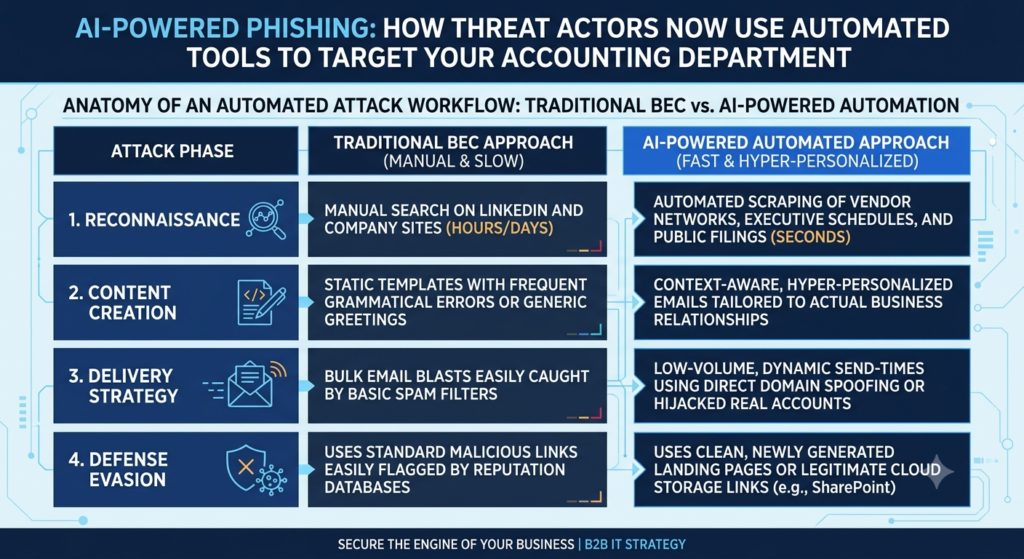
As demonstrated above, the speed and sophistication of these campaigns have completely outstripped human detection capabilities. When an attack vector moves this fast, trusting a busy accountant to “spot the fake” is no longer a viable security policy.
The Structural Vulnerabilities Threat Actors Exploit
Understanding the technology is only half the battle; we must also examine the operational gaps within our own teams.
Operational Fatigue
Accounting teams face intense deadline pressure during monthly closes, tax seasons, and payment cycles. When an automated threat tool sends a urgent invoice request at 4:45 PM on a Friday, it exploits cognitive weariness rather than technical ignorance.
Single-Factor Approvals
Many mid-sized firms still rely on a single channel—email—to verify changes to sensitive vendor payment data. If an email looks authentic and references a real project, employees frequently fast-track approval without out-of-band verification.
Legacy Email Gateways
Traditional Secure Email Gateways (SEGs) look for known malicious signatures, bad reputation IPs, or payload viruses. AI-generated text contains no malware code; it is simply persuasive language delivered from newly created or compromised legitimate accounts.
Actionable Defense Strategies for Leadership
Protecting your accounting team requires a blend of technical safeguards, modern operational protocols, and cultural adjustments.
Here is how mid-market leadership teams can neutralize AI-driven threat tools today:
1. Implement Out-of-Band (OOB) Verification Policies
Establish a strict, non-negotiable rule: No banking detail, wire instruction, or ACH routing change is processed based on an email alone.
- Require a mandatory voice phone call to a pre-established, verified number.
- Require dual-authorization on all outbound payments over a predefined financial threshold.
2. Upgrade to Behavioral AI Email Security
Replace signature-based email filters with Integrated Cloud Email Security (ICES) platforms.
- These platforms use computer vision and natural language processing to evaluate context.
- They flag emails that display subtle anomalies, such as a sudden shift in tone, an unusual request timing, or a newly registered domain resembling a trusted partner.
3. Transition to Hardened Authentication
Enforce phishing-resistant Multi-Factor Authentication (MFA) across all corporate accounts.
- Upgrade from SMS or push-notification MFA to FIDO2-based hardware keys or managed authenticator applications to prevent session hijacking.
4. Run Modern, Scenario-Based Simulations
Move away from generic, obvious phishing tests.
- Train your finance personnel using realistic, high-urgency scenarios involving vendor updates and executive requests.
- Treat mistakes as learning opportunities rather than punitive events to encourage immediate incident reporting.
Securing the Engine of Your Business
Cybercriminals will always follow the path of least resistance to the highest payout, and right now, automated tools have focused their sights squarely on your financial workflows.
The goal is not to turn your accounting team into security analysts. Their job is to keep the financial engine of your enterprise running smoothly.