Introduction to Secure Data Archiving
As a business owner or manager, you focus on providing excellent service, managing your team, and growing your company. Technology should support these goals, not complicate them. One area that often feels technical but is actually critical to your business operations and legal standing is how you manage and keep old client data.
This is where secure data archiving and retention comes in. Think of it as the responsible, organized way of moving files that you no longer use daily into a safe, long-term storage solution. It is not just about freeing up space. It is a fundamental practice that protects your business from legal risks, helps you meet industry regulations, and keeps your current operations fast and efficient.
At Ai Tech Pros, we believe in making technology human. We want you to understand that this process is simply about putting your digital house in order so you can focus on your clients, knowing your past information is securely handled.
What Exactly is Secure Data Archiving
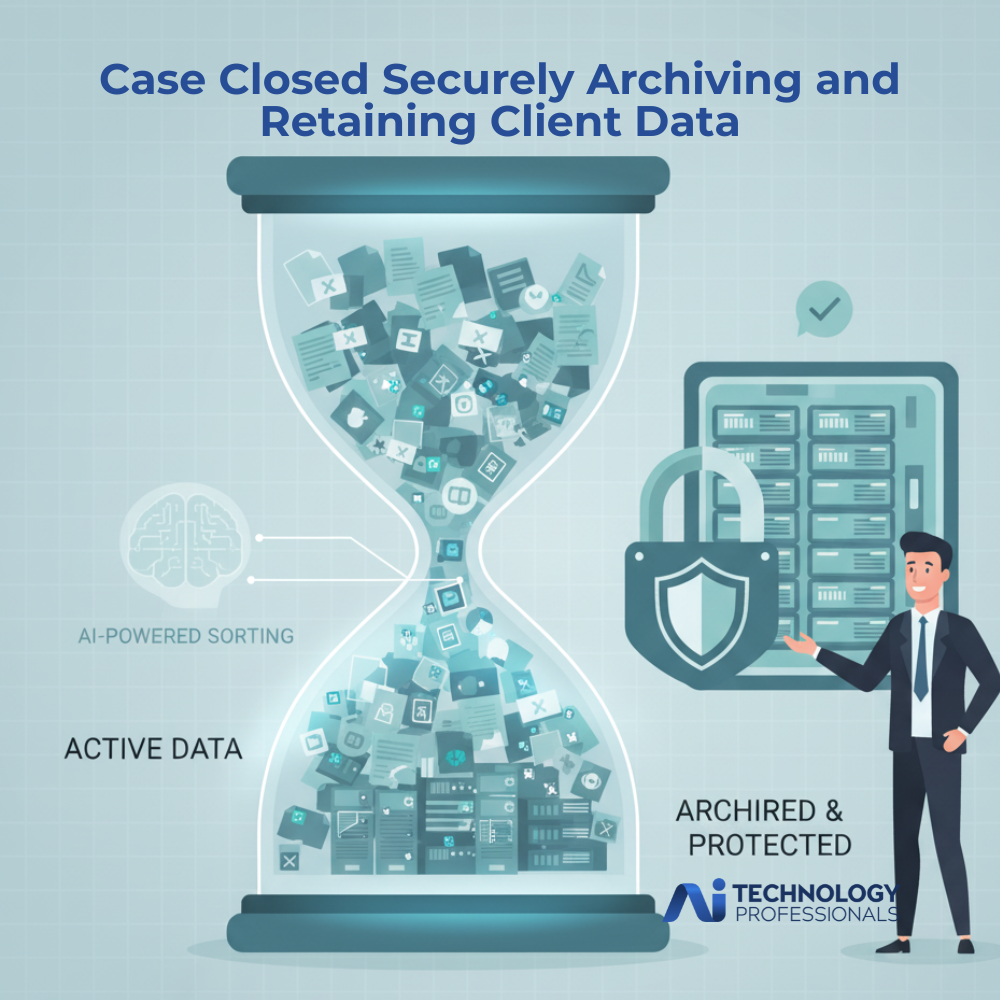
Data archiving is the process of safely moving data that is no longer active but must be kept for future reference or compliance purposes. It is a strategic approach that separates essential, current data from valuable, historical data.
To make this concept straightforward, think of data archiving using a few simple analogies:
- The Business Storage Unit Analogy: Imagine your office filing cabinets. You keep the folders you use every day right next to your desk. But you do not throw away old client contracts from five years ago. Instead, you box them up, label them clearly, and move them to a secure, climate-controlled storage unit. Data archiving is the digital equivalent. You move those old, inactive files off your live network and into a secure digital vault.
- The Library Analogy: Your active data is like the New Releases section in the front of the library. Everyone checks those out frequently. Your archived data is like the vast collection of historical journals and books in the back stacks. They are still available, important, and well-cataloged, but they are not clogging up the main flow of traffic.
- The Three Key Parts of the Process: Data archiving is a controlled, three-part activity:
- Identification: Determining which data is truly inactive, meaning it has not been accessed or edited recently, but still holds long-term value.
- Migration: Securely transferring that identified data to a long-term, cost-effective storage location, often off-site or in a specialized cloud service.
- Retention Policy: This is the most important part. It is the set of rules that dictates exactly how long you must keep certain types of data before it can be safely and permanently deleted, based on legal or regulatory requirements.
In short, it is the difference between throwing everything into a messy attic and intentionally placing important, inactive items into a labeled box in a secure warehouse.
The Clear Benefits for Your Business
Implementing a solid data archiving and retention strategy delivers tangible results that directly impact your bottom line and operational stability. It is an investment in stability, security, and efficiency.
- 1. Significant Reduction in Storage Costs
Active, high-speed storage—the kind your daily operations rely on—is expensive. Archiving moves inactive data to less-expensive, long-term storage tiers, which are specifically designed for data that is rarely accessed. This dramatically reduces the amount of expensive high-speed storage you need, leading to noticeable savings on your monthly IT bill. You are paying less to store data that is just sitting there.
- 2. Meeting Legal and Regulatory Requirements
Depending on your industry—whether finance, healthcare, legal, or even just general business—you are legally required to keep certain records for a specific number of years. An archiving system ensures you automatically comply with these retention periods. If you ever face an audit or litigation, having a proven, documented system for preserving and quickly retrieving specific data is indispensable and can save you massive fines and legal fees.
- 3. Improved System Performance and Speed
The more data your live operating systems and servers have to sort through every day, the slower they become. By archiving old, unused data, you are essentially decluttering your live network. This allows your day-to-day applications, databases, and backup processes to run much faster and more efficiently, leading to less employee frustration and smoother operations.
- 4. Enhanced Security and Data Protection
Archived data is typically stored on systems with a different, often higher, level of security and access control than day-to-day data. Since it is segregated, it limits the risk of a ransomware attack or accidental deletion affecting your entire historical record. This separation protects your most sensitive, irreplaceable historical data.
- 5. Easier Data Recovery from Disasters
With a clear archiving strategy, your backup process is streamlined. You only need to back up the smaller volume of active, essential data every night. This makes the backups much faster and, crucially, makes recovering from a server failure or disaster much quicker because your IT team is not wading through years of unnecessary, inactive files.
The High Cost of Ignoring Data Archiving
Failing to implement a secure, systematic approach to data retention and archiving is not just messy—it exposes your business to severe and preventable risks.
- Unnecessary Financial Waste on Storage
Without archiving, you pay premium prices for active storage for every single client email and document you have ever created. It is like paying rent on an entire warehouse when 90 percent of what is inside is just old boxes you look at once a year. This unchecked data growth continuously drives up your operational costs with no added business value.
- Fines and Legal Liability
The biggest risk is often legal. If you are required by law to keep a certain financial record for seven years, and you destroy it after three, your business is instantly non-compliant and faces heavy financial penalties. Conversely, if you are legally required to delete personal client data after a certain period and fail to do so, you can also be penalized. Retention is a balancing act that requires a clear plan.
- Extended Downtime and Recovery Challenges
In the event of a system crash, the time it takes to restore your entire business network is directly proportional to the amount of data you have. A business that has kept twenty years of unnecessary data on its live servers will take significantly longer to recover than one that only needs to restore its active, essential data. This extended downtime means lost revenue, missed deadlines, and damaged client trust.
- Security Gaps and Increased Breach Risk
Old, forgotten systems and massive volumes of data create a larger target for cyber criminals. Every piece of data you hold is a potential liability if breached. An archive strategy helps you identify and permanently eliminate data that you are no longer legally required to hold, reducing your overall digital footprint and lowering the risk surface for a catastrophic data breach.

Conclusion
For a business owner, technology should provide clarity and security, not complexity. Securely archiving and retaining client data is a perfect example of a foundational IT practice that directly serves your most important business goals—protecting your clients, maintaining legal compliance, and ensuring your business runs efficiently.
At Ai Tech Pros, our approach is Human-Driven and AI-Powered. We use smart, automated tools to manage the intricate details of data retention policies, but the strategy is always driven by understanding your unique business and its needs. We take the technical headache of compliance and secure storage off your plate, allowing you to focus on the human connections that drive your success. By partnering with us, you can be sure the case is closed on your historical data—it is secure, compliant, and ready if you ever need it.