The Executive Reality:
Your cloud environment scales by the second, which means your attack surface does too.
The Core Disconnect:
Native cloud security tools rarely communicate seamlessly across multi-cloud environments. This creates operational blind spots that automated threat actors can exploit in a matter of minutes.
The CSPM Advantage:
You gain continuous, automated visibility that catches and corrects infrastructural drift the exact moment an engineer leaves a data bucket exposed or an IAM policy too loose.
We need to have an honest conversation about business agility. Your development teams are moving faster than ever before. They are spinning up new environments, deploying code daily, and tearing down infrastructure just as quickly to keep pace with market demands. This velocity is exactly what the business required to stay competitive.
But it has created a terrifying byproduct: continuous infrastructural drift.
A modern cloud environment is never static. It is a living, breathing ecosystem where thousands of configuration changes happen every single week. Most catastrophic data breaches you read about in the news aren’t the result of sophisticated, state-sponsored zero-day exploits. They are the result of simple, entirely avoidable human error.
An engineer temporarily opens an S3 bucket to the public to troubleshoot a difficult third-party API integration, and simply forgets to close it before logging off. A database snapshot is backed up with overly permissive access rights.
Hackers aren’t breaking down your digital doors anymore. They are just running automated scripts to find the doors you accidentally left wide open.
The Gap Between Provisioning and Protection
Historically, IT leadership viewed infrastructure as something you build once and secure with a hardened perimeter. You buy the firewalls, you lock down the network layer, and you run a compliance audit every quarter.
In the cloud, that perimeter is entirely gone. Identity and configuration are your new perimeters.
When your enterprise operates across AWS, Azure, or Google Cloud—or all three simultaneously—the sheer volume of native security controls is staggering. Each provider has its own highly unique identity structures, network security groups, and storage policies.
Expecting a human security team to manually audit this chaotic web of settings across hundreds of dynamic workloads is an impossible ask. It is mathematical suicide for your risk posture. The moment your quarterly or even weekly manual audit is complete, the environment has already changed. Someone just pushed a new container to production, and your perfectly clean audit report is suddenly obsolete.
Enter Cloud Security Posture Management (CSPM)
This is where Cloud Security Posture Management stops being a vendor buzzword and becomes a foundational survival mechanism for your business. CSPM isn’t just another passive dashboard for your security operations center to ignore. It is an automated, continuous watchdog that integrates directly into your cloud fabric via APIs.
Instead of asking, “Were we secure yesterday?”, a mature CSPM architecture asks, “Are we secure right this exact second?”
It works by constantly comparing your actual, live cloud configurations against established security baselines and global compliance frameworks. Whether your industry requires you to adhere to SOC 2, HIPAA, PCI-DSS, or CIS benchmarks, CSPM translates those complex legal requirements into active technical policies.
If a developer inadvertently violates a policy, CSPM catches the misconfiguration in real-time. But visibility without action is just expensive overhead. The true transformative power of a mature CSPM strategy lies in automated remediation.
When a critical data store is suddenly exposed to the public internet, you don’t want a ticketing system pinging a sleeping engineer at 3:00 AM. You want the system to instantly revoke the public access, log the incident, and then notify the team that the threat was already neutralized.
Let’s look at exactly how traditional cloud security compares to a fully realized CSPM environment.
Visibility:
Traditional: Fragmented blindly across native, disconnected cloud provider dashboards.
CSPM: Unified, single-pane-of-glass oversight across AWS, Azure, and GCP simultaneously.
Discovery Pace:
Traditional: Point-in-time scanning that leaves vulnerabilities exposed for days or weeks.
CSPM: Continuous, API-driven monitoring that detects drift in milliseconds.
Remediation:
Traditional: Manual ticketing systems relying entirely on delayed human intervention.
CSPM: Automated, immediate policy enforcement and auto-correction of critical risks.
Compliance Mapping:
Traditional: Manual spreadsheet audits requiring massive engineering hours and cross-team friction.
CSPM: Out-of-the-box, real-time mapping to global regulatory frameworks.
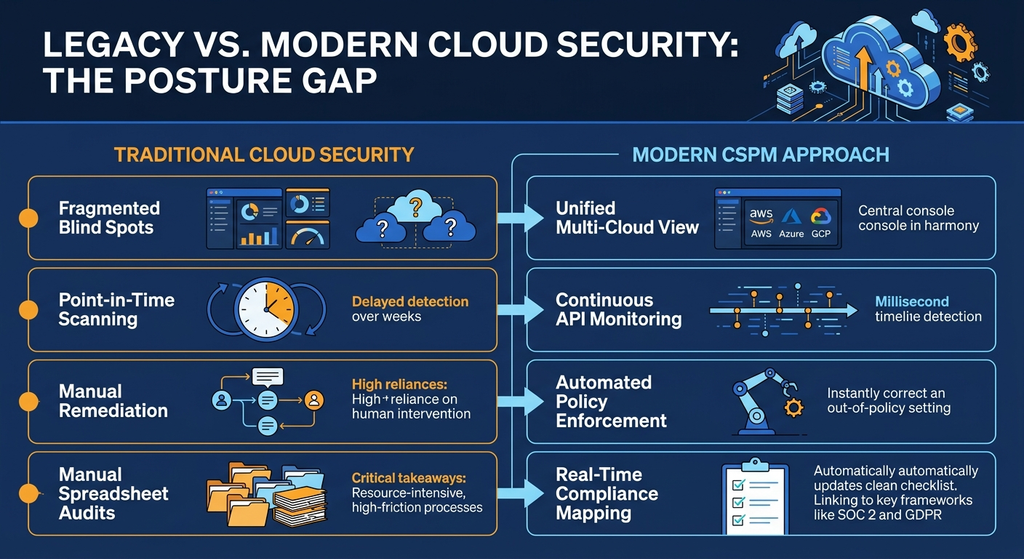
As you can see, the shift is fundamentally about removing the human bottleneck from the detection and remediation loop. We aren’t replacing the security team; we are arming them with the reflex speed required to survive in a dynamic cloud.
The Real-World Business Impact
Let’s elevate this conversation beyond the technical weeds. Why does the C-suite and the board of directors need to care about posture management?
First, it protects the brand equity you have spent decades building. A single misconfigured database can effortlessly expose millions of customer records. The resulting regulatory fines, the class-action lawsuits, and the massive erosion of consumer trust are catastrophic business events, not just isolated IT hiccups.
Second, it drastically accelerates time-to-market. Security is historically viewed by engineering as the “Department of No.” Security teams slow down developers because they have to manually check every deployment. By integrating CSPM early into your CI/CD pipelines—a practice often called “shifting left”—you empower developers to build incredibly fast.
They get immediate, automated feedback if a deployment violates a security policy, long before that code ever hits production. Security becomes an automated guardrail on the highway, rather than a tollbooth slowing down traffic.
Eliminating the Threat of Alert Fatigue
One of the most valid concerns I hear from IT leaders evaluating new security tooling is the fear of alert fatigue. You don’t want to invest in a platform that just generates ten thousand low-priority warnings a day, teaching your team to ignore everything.
Modern CSPM platforms use deep contextual risk analysis to solve this exact problem.
A software vulnerability on an isolated, internal test server is technically a risk, but it isn’t an emergency. However, an overly permissive IAM role attached to an internet-facing EC2 instance that has direct access to a production customer database? That is a five-alarm fire.
An intelligent CSPM correlates the misconfiguration with network exposure, data sensitivity, and identity access. It prioritizes the alerts based on actual, exploitable blast radius, telling your team exactly what to fix first to prevent a breach today.
The “Day Zero” Actionable Implementation Strategy
If you are operating in the cloud without continuous posture management, the time to act is right now. The bad actors are already using automated scanners to look for your mistakes; you need an automated scanner to find them first.
Here is how you bridge the gap and start taking control of your cloud environment this week.
Establish your true baseline immediately. You cannot protect what you cannot see. Connect a CSPM tool to your cloud APIs in read-only mode to generate an unfiltered, brutally honest map of your current asset inventory and risk posture.
Target the most critical low-hanging fruit. Do not try to boil the ocean on day one. Configure your platform to look exclusively for the top three critical risks: unencrypted data stores, public-facing storage buckets, and multi-factor authentication (MFA) failures on highly privileged accounts.
Align with a single, foundational compliance framework. Pick one universally respected benchmark, such as the CIS Foundations Benchmark, and measure your entire environment against it. Use this initial quantifiable score to secure buy-in from the board for further remediation efforts.
Gradually introduce automated remediation. Start by automating rich, contextual notifications to the specific engineering teams responsible for the infrastructure. Once absolute trust is established in the tool’s accuracy, turn on automated remediation for high-risk, non-disruptive misconfigurations.
The Wrap-Up
Moving your operations to the cloud was supposed to make your business more agile, scalable, and resilient. It absolutely can, and it should.
But that agility requires a fundamental, non-negotiable shift in how your leadership views security. You can no longer rely on human perfection to manage superhuman infrastructural complexity.
Cloud Posture Management is the crucial bridge between your business’s need for speed and your absolute mandate for security. It provides the continuous oversight necessary to let your developers run fast, knowing there is an automated safety net catching their missteps before hackers ever get the chance.
Your infrastructure is dynamically changing right now as you read this.