Introduction to Adopting a Zero Trust Architecture
As a business owner or non-technical manager, you might hear a lot of buzzwords about technology and security. One concept you need to understand right now is Zero Trust Architecture. This is not just a passing trend. It is the new foundation for modern business security, and understanding it is critical for protecting your company’s assets.
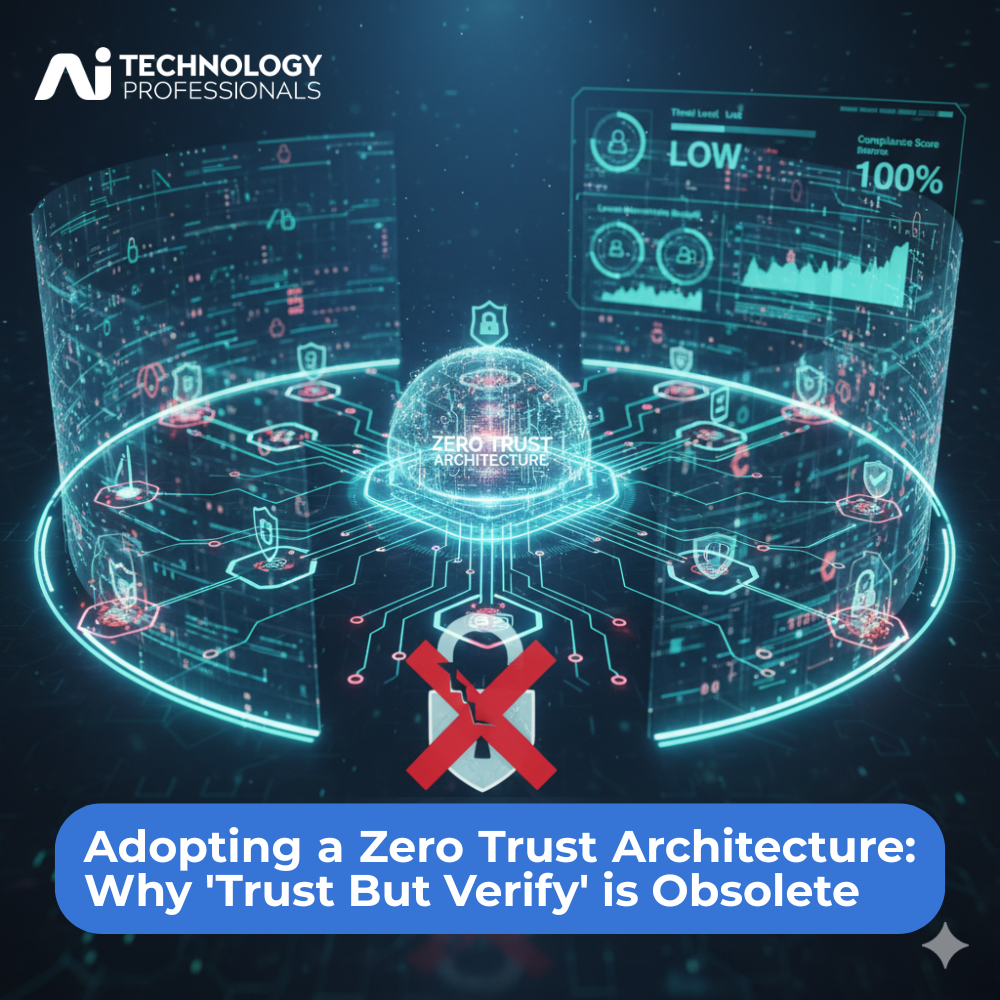
For decades, the standard approach to network security was like a castle and moat. Once you were inside the castle walls—your corporate network—you were largely trusted. This was the “trust but verify” model. It meant that a person or device that successfully logged in was given wide access to resources, assuming they were safe.
That approach is now obsolete. The modern workplace is no longer a simple castle. Your employees work from home, in coffee shops, on different devices, and they access cloud applications. There is no single “inside” anymore. Ai Tech Pros embraces the reality that threats can come from anywhere, even from within your own network. Zero Trust is our answer to making sure your technology remains both secure and human-friendly, no matter where your team is working.
What Exactly is Zero Trust Architecture
Zero Trust Architecture is a strategic approach that dictates no person, device, or application is inherently trusted, regardless of location. Every single request for access to any resource must be verified, every time. Think of it as replacing the single castle gate with a security checkpoint at every single door inside the building.
Here are a few simple ways to break down this powerful security model:
- Never Trust Always Verify
The core principle is simple: assume every access attempt is a potential threat until proven otherwise. Instead of trusting a person just because they logged in this morning, the system checks their identity, their device’s health, and their need to access that specific file or application before granting access to it. It is continuous verification, not a one-time check.
- The Principle of Least Privilege
This means giving every user the absolute minimum level of access they need to do their job—and nothing more. If a marketing manager only needs access to the marketing files, they should not be able to see the financial records. It is like giving a temporary access card for a specific room only, instead of a master key to the entire building. This drastically reduces the damage a hacker can do if they manage to compromise one account.
- Security Follows the Resource, Not the Perimeter
In the old model, security was focused on the perimeter—the firewall protecting the network. In Zero Trust, the protection is wrapped around the data and applications themselves. This is essential because your data is no longer stored only on your office servers. It lives in the cloud, on laptops, and in various applications. Zero Trust ensures the security measures travel with the resource, wherever it goes.
- Micro-Segmentation of the Network
Imagine your company network is a single, open office floor. If a bad actor gets in, they can walk anywhere. Micro-segmentation is like building clear, individual offices with locked doors on that floor. It divides the network into tiny, isolated zones. If one small segment is breached, the attacker cannot easily move to other areas of the network, containing the damage immediately.
The Clear Benefits for Your Business
Adopting a Zero Trust Architecture is not just a technical upgrade. It is a strategic business decision that delivers measurable value across security, efficiency, and financial health.
- Dramatically Reduced Risk of Data Breach
By eliminating implicit trust and enforcing least privilege access, Zero Trust significantly shrinks your “attack surface.” If a hacker steals an employee’s password, they will only gain access to a tiny, isolated segment of your data, preventing the widespread data breach that can ruin a company’s reputation and finances. This continuous verification process acts as a dynamic shield, making unauthorized access far more difficult.
- Seamless and Secure Remote Work
For businesses that rely on a hybrid or fully remote workforce, Zero Trust is essential. It allows employees to securely access company resources from anywhere in the world, on any device, without needing a complicated Virtual Private Network or risking security. This flexibility enhances employee productivity and morale while keeping your assets safe.
- Simplified Compliance with Regulations
Many industry regulations, such as those related to finance or healthcare data, require strict controls over who can access sensitive information. Zero Trust’s core principles—verifying every access request and enforcing least privilege—naturally align with and help streamline compliance efforts. It provides clear, verifiable audit trails proving that access to sensitive data is strictly controlled.
- Improved Operational Efficiency and Speed
While it sounds more restrictive, Zero Trust actually makes operations faster and cleaner. Because it moves past the complicated, outdated, perimeter-based security systems, it allows for faster integration of new cloud applications and services. When security is automated and built into the access flow, employees spend less time dealing with clunky, frustrating login systems and more time focused on their actual work.
The High Cost of Ignoring Zero Trust Architecture
Choosing to stick with the old “trust but verify” model is choosing to live with unnecessary and costly risks. For general business owners, the consequences of security complacency are tangible and often devastating.
- Massive Financial Losses from Breaches
A successful data breach is one of the single largest threats to a modern business. This financial toll includes the direct costs of paying for security forensic investigations, mandatory customer notifications, credit monitoring services, and regulatory fines. These costs can easily run into the tens or even hundreds of thousands of dollars, an expense few small to midsize businesses can absorb without significant hardship.
- Extended Business Downtime and Disruption
When a security incident occurs, whether it is a ransomware attack or a hacker gaining control of key systems, the first step is often to shut down the affected parts of the network. This leads to immediate and costly downtime. Employees cannot access the files or applications they need to work. Sales halt. Services stop. Even a few days of total disruption can critically damage a business’s annual performance and operational stability.
- Reputational Damage and Loss of Customer Trust
In the digital age, customers and partners expect companies to protect their data. A security breach is often public knowledge. When news of a breach breaks, the resulting damage to your company’s reputation can be long-lasting. Customers may switch to a competitor, and partners may reconsider doing business with you, leading to a critical loss of revenue and market standing that is difficult to recover from.
- Operational Headaches and Complex Management
Outdated security architecture is inherently complex and brittle. It requires constant patching and maintenance, often leading to frustrating issues for employees who struggle with slow or restricted access. By contrast, Zero Trust Architecture simplifies the security environment over time by standardizing verification across all resources, ultimately reducing the administrative burden on your internal or external IT team.
Conclusion
The adoption of a Zero Trust Architecture is the logical next step for any forward-thinking business. It moves security from a cumbersome barrier to an invisible, intelligent layer that protects your company without impeding your team. It is the core of how Ai Tech Pros operates.
We believe in a Human-Driven, AI-Powered approach. Zero Trust is AI-Powered because it uses intelligent, continuous verification to secure every interaction. It is Human-Driven because its ultimate purpose is to free your employees to work securely and productively, wherever they are, without the constant fear of a breach looming over their heads.
By abandoning the obsolete idea of “trust but verify,” you are not just buying new software. You are investing in a future where your technology is inherently safe, allowing your managers and employees to focus entirely on growth and success.