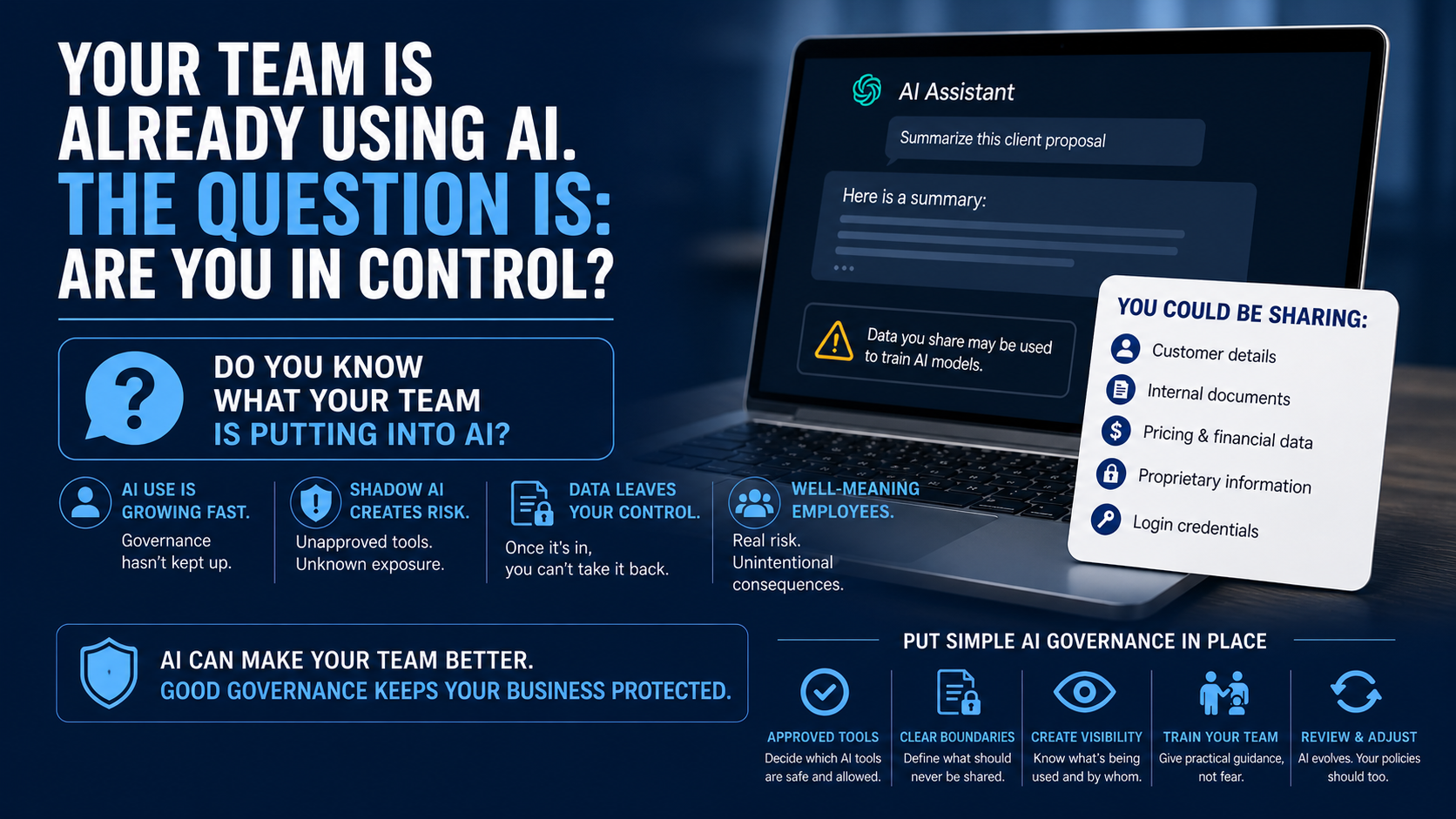

Hook: “Do You Know What Your Team Is Putting Into AI?”
Let’s start with a slightly uncomfortable question.
Do you know which AI tools your team is using… and what they’re putting into them?
Most business owners around Richmond will say yes.
And then we take a closer look.
That’s usually where things get interesting.

The Problem: AI Adoption Is Moving Faster Than Oversight
Tools like ChatGPT and Gemini didn’t roll in slowly.
They showed up, proved useful, and became part of the workday almost overnight.
We see this all the time. Someone uses AI to draft an email. Then summarize a document. Then brainstorm ideas.
Before long, it’s part of how work gets done.
That sounds like progress.
But here’s the catch.
Governance hasn’t kept up.
AI usage inside businesses has grown quickly, and people aren’t just experimenting anymore. They’re relying on it.
At the same time, a large portion of that usage is happening outside of approved systems.
Personal accounts. Unsanctioned apps. Tools the business doesn’t control or even see.
That’s what’s known as shadow AI.

Simple Explanation: Why This Creates Risk
Using AI isn’t just asking questions.
It’s sharing information.
Every time someone pastes something into an AI tool, they’re potentially sending:
- Customer details
- Internal documents
- Pricing or financial data
- Proprietary business information
- In some cases, even login details
Most of the time, it’s not intentional.
It’s someone trying to get their work done faster.
But once that information leaves your environment and goes into an unapproved tool, you lose visibility and control.
That sounds fine until something sensitive slips through.

Real-World Example: How This Happens
Let’s say you run a business in Glen Allen.
Someone on your team is working on a proposal.
They drop a client document into a personal AI account to “clean it up” or summarize it.
Quick. Easy. Helpful.
But now ask a few questions:
- Was that tool approved for handling client data?
- Is that information stored somewhere outside your control?
- Does it align with your data policies or contracts?
Nobody meant to create risk.
But it happened anyway.
We’ve seen versions of this across all kinds of businesses, from accounting firms to contractors.

The Solution: Put Simple, Clear AI Governance in Place
This isn’t about banning AI.
That’s not realistic, and honestly, it’s not helpful.
AI can absolutely improve productivity when used the right way.
The goal is to guide it, not ignore it.
Here’s what that looks like in practice:
Decide which AI tools are approved
Give your team clear options they can use safely.
Set boundaries on what can be shared
Spell out what should never be pasted into AI tools.
Create visibility
Make sure usage isn’t happening completely off the radar.
Train your team
Not with scare tactics. Just clear, practical guidance.
Review and adjust over time
This space is moving fast. Your approach should too.
This is about reducing risk and keeping control, not slowing people down.

Key Takeaways
- AI use in the workplace is growing fast and becoming part of daily work
- Much of that use happens in unapproved tools, known as shadow AI
- Sharing data with AI tools means giving that data to systems you may not control
- Risk often comes from well-meaning employees, not bad intent
- Clear policies and guidance are essential to manage AI safely

CTA: Let’s Put Some Guardrails Around AI Use
AI isn’t going anywhere.
Ignoring it doesn’t make it safer. It just makes it harder to manage.
If you’re not sure how your team is using AI or what policies you should have in place, it’s worth a conversation.
We can help you put simple, practical guardrails in place so your team can use AI confidently without putting your business at risk.
No pressure. Just a clear plan that makes sense for how you actually work.