Organizations rely heavily on enterprise software to power everything from core operations to customer-facing platforms. Yet, behind the slick interfaces of modern applications lies an intricate network of third-party libraries, open-source frameworks, and nested code dependencies. Most leadership teams have no visual line of sight into this digital assembly line.
The Software Bill of Materials (SBOM) changes that equation. An SBOM acts as a detailed, machine-readable inventory of every ingredient baked into your software applications. Understanding and demanding transparency across your digital supply chain is no longer just a technical exercise—it is an urgent operational necessity for maintaining cyber resilience, regulatory compliance, and business continuity.
Executive Summary & Key Takeaways
- The Invisible Risk: Up to 80% or more of modern software consists of open-source components and third-party code libraries. Without an SBOM, enterprise security teams remain blind to critical vulnerabilities lurking deep within their application stacks.
- Rapid Incident Response: When zero-day vulnerabilities emerge (such as the widespread Log4j crisis), organizations with active SBOM practices can locate impacted systems in minutes rather than spending weeks running manual code audits.
- Regulatory Compliance Pressure: Government bodies, defense sectors, and insurance providers increasingly mandate detailed SBOM disclosures as a prerequisite for enterprise contracts and coverage.
- Proactive Risk Management: Implementing an SBOM strategy transforms software security from a reactive patching scramble into a structured, continuous governance framework.
The Enterprise Blind Spot: Trusting the Unseen Supply Chain
Consider how modern manufacturing operates. An automotive company would never install an engine without knowing every sub-component’s source, safety rating, and manufacturing history. If a defective airbag needs a recall, the manufacturer can immediately pinpoint every impacted VIN off the production line.
In enterprise software engineering, however, companies have operated under a vastly different model for decades. Development teams regularly integrate open-source packages to build features faster. While this accelerates speed-to-market, it introduces an unmapped layer of third-party code into critical infrastructure.
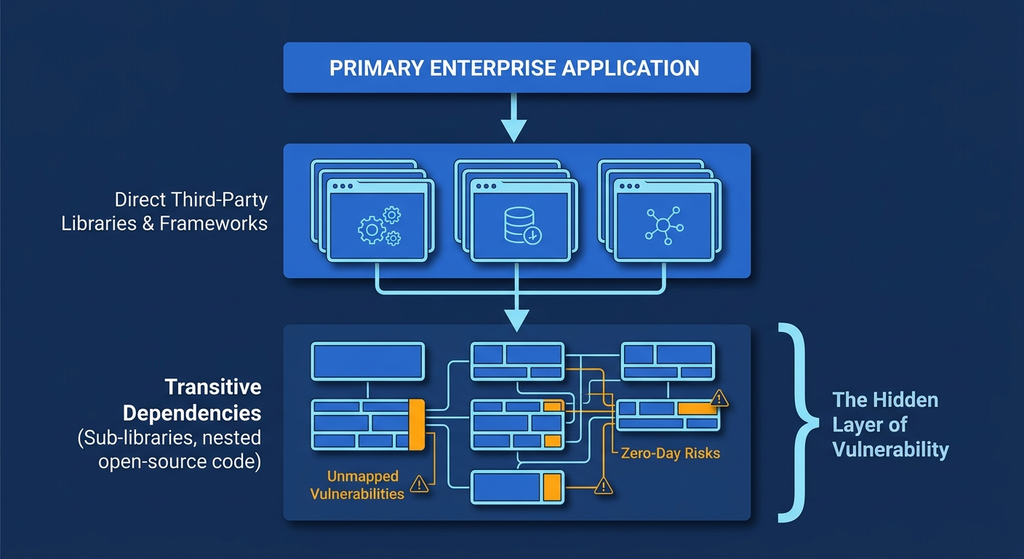
The diagram above illustrates how deep software dependencies can stack up. When an application calls a single trusted library, that library frequently imports dozens of other sub-dependencies. A single vulnerability buried three levels deep exposes your entire organization to potential exploitation.
Deconstructing the Technical Mechanics of an SBOM
To manage digital supply chain risk effectively, business leadership must understand what an SBOM actually contains and how it functions inside an enterprise environment.
What Is Included in a Standard SBOM?
An effective SBOM provides standardized, machine-readable metadata about every component within an application. Under guidelines established by cybersecurity authorities like CISA, a comprehensive SBOM must record:
- Supplier Name: The original creator or vendor of the component.
- Component Name: The exact designation of the library, module, or framework.
- Component Version: The precise version release to track known bugs or fixes.
- Other Unique Identifiers: Universal keys (such as CPEs or PURLs) that map directly to global vulnerability databases.
- Dependency Relationships: A explicit map showing how components link together and depend on one another.
Transitive Dependencies: The Hidden Layer of Vulnerability
The real power of an SBOM lies in tracking transitive dependencies. A direct dependency is a software library your team explicitly downloaded and chose to use. A transitive dependency is a library that your direct library relies on to function.
When security researchers discover a severe flaw in a low-level utility library, traditional scanning tools often miss it if it sits beneath a primary framework. An active SBOM continuously parses these complex dependency trees, giving security leaders complete visibility down to the root level.
Standardized Formats: SPDX and CycloneDX
An SBOM is not an informal Excel spreadsheet managed by an IT administrator. It is an automated document generated during the continuous integration and continuous delivery (CI/CD) build process.
The industry relies on two primary open standards:
- CycloneDX: Created specifically for security contexts and supply chain analysis, offering detailed capabilities for tracking software components and vulnerabilities.
- SPDX (Software Package Data Exchange): An ISO standard designed to track software package data, copyright information, and licensing compliance across enterprise environments.
Both standards ensure that human teams and security automation software can immediately read, aggregate, and act upon supply chain data.
The Business Case: Why SBOMs Are Essential for Leadership
Managing an SBOM program is not simply a technical task for engineering teams; it provides direct strategic value to C-level executives, board members, and risk managers.
1. Accelerating Incident Response Times
When a major vulnerability becomes public knowledge, the immediate question from executive leadership is simple: Are we affected, and where?
Without an SBOM catalog, IT and security teams must pause active development work, search through millions of lines of code across dozens of repositories, and manually test production systems. This process takes days or weeks, leaving a massive window of exposure for attackers.
With a centralized SBOM repository, security teams can run a query across every deployed application in seconds, immediately pinpointing which servers host the vulnerable library.
2. Streamlining Regulatory Compliance and Procurement
Government agencies around the world now require software providers to produce verified SBOMs to qualify for contract awards. Private enterprise buyers are adopting the same standards during vendor risk assessments.
If your company sells software or offers SaaS platforms, providing transparent SBOM disclosures builds immediate credibility and speeds up complex enterprise procurement cycles. Conversely, failing to produce an SBOM can stall major deals during technical due diligence.
3. Managing Open-Source Licensing Liabilities
Software security is not the only risk hidden inside third-party code. Open-source libraries carry various software licenses, some of which contain strict copyleft provisions (such as GPL licenses).
Inadvertently bundling copyleft code into proprietary commercial software can legally force a company to open-source its IP or face copyright litigation. An SBOM tracks software licensing across all integrated packages, preventing costly legal oversights before products launch.
A Practical Roadmap for Implementing an SBOM Framework
Building a robust digital supply chain governance strategy requires clear priorities, automated tooling, and operational alignment across engineering, IT, and security functions.
Step 1: Automate SBOM Generation in Your CI/CD Pipeline
Manual inventory tracking is ineffective for modern software development. Introduce automated generation tools directly into your build systems. Every time your engineering team compiles a new software release, the build pipeline should automatically produce an updated, version-controlled SBOM file.
Step 2: Establish a Centralized SBOM Repository
Generating isolated SBOM files across scattered development teams creates management silos. Deploy a centralized software component management system that ingests all SBOM outputs, maps them against national vulnerability databases in real time, and alerts security teams to emerging threats automatically.
Step 3: Require SBOM Disclosures from Third-Party Software Vendors
Extend your digital supply chain requirements outward. When procuring commercial off-the-shelf software or third-party platforms, require enterprise vendors to provide certified SBOMs as part of their standard contract deliverables. Make supply chain transparency a core procurement criterion.
Key Questions for Executive Leadership
To evaluate your organization’s current readiness, bring these diagnostic questions to your next technology strategy review:
- How long would it take our technical teams to verify whether a newly disclosed critical vulnerability exists inside our production applications?
- Do our current vendor risk assessments require software providers to disclose their software component dependencies via standard SBOM formats?
- Are automated tools running in our development pipeline to block unauthorized open-source components before they reach production?
Reclaiming Control Over Your Digital Infrastructure
In an era of increasingly complex software environments, operating without visibility into your software ingredients is an unacceptable business risk. Ignorance of nested dependencies does not shield an enterprise from breach liability, unexpected operational downtime, or regulatory penalties.
Implementing a Software Bill of Materials framework shifts your organization from reactive fire-fighting to proactive digital supply chain governance. By demanding transparency across the software you build, buy, and operate, you build a resilient enterprise foundation capable of enduring evolving cybersecurity challenges.