Executive Summary:
Modern enterprise IT infrastructure cannot afford the luxury of scheduled, extended maintenance windows. Deploying zero-day security patches across distributed global operations without triggering operational outages requires moving from manual, batch-based deployment models to progressive, intelligent, and highly automated orchestration frameworks.
Key Takeaways for Business Leadership
- The Downtime Paradox: Delaying critical security patches to avoid disruption significantly increases your exposure window to modern zero-day threats.
- Progressive Rollouts: Risk mitigation relies on canary deployments, deployment rings, and health-checked automation rather than “big bang” global pushes.
- Real-Time Observability: Automated rollback triggers based on application performance telemetries prevent regional patch failures from escalating into global outages.
- Orchestration Over Automation: Scripting patch installations is not enough; modern architectures require context-aware orchestration aligned with global operational hours.
The High-Stakes Dilemma of Global Patching
Every enterprise leader recognizes the anxiety: a critical zero-day vulnerability drops on a Tuesday afternoon, carrying a CVSS score of 9.8. Your CISO demands immediate remediation across thousands of servers, cloud environments, and remote edge endpoints worldwide.
Simultaneously, your Chief Revenue Officer reminds you that every minute of application downtime costs tens of thousands of dollars in direct losses and service-level agreement (SLA) penalties.
This operational friction creates a dangerous paralysis. Organizations often delay critical patching for days or weeks to schedule multi-region maintenance windows, creating a massive target window for threat actors actively scanning the public internet.
The fundamental disconnect in modern IT strategy isn’t a lack of patch management tools—it is the reliance on legacy, all-or-nothing deployment models in a 24/7 global economy where traditional maintenance windows no longer exist.
Why Patch Deployments Trigger Global Outages
To understand why automated updates cause catastrophic failures, we must look at how legacy patching strategies interact with modern distributed architectures.
The Failure of “Big Bang” Deployments
Historically, IT teams relied on central management servers to push updates to all endpoints simultaneously during low-traffic hours. In a globally distributed organization operating across multiple time zones, true “low-traffic” windows rarely exist. Pushing a patch globally at a single point in time guarantees that at least one region is experiencing peak business activity.
Unhandled Microservice Dependencies
Modern enterprise software relies on complex webs of microservices, database schemas, and third-party APIs. When an automated patching script reboots a core database node or updates an underlying kernel library without dynamically assessing upstream and downstream service dependencies, cascade failure occurs instantly.
Opaque Observability Loops
Most standard patch management software only checks whether an update returned a “Success” exit code (Code 0) from the operating system installer. Standard installers do not evaluate whether the core business applications running on that server survived the reboot or can still process active transaction queues.
Designing a Zero-Downtime Global Patch Architecture
To deploy updates continuously without risking operational continuity, progressive enterprise teams adopt a risk-mitigated rollout methodology.
1. Multi-Tier Deployment Rings
Rather than viewing infrastructure as a single target, modern orchestration divides global assets into progressive rings.
- Ring 0 (Canary Environment): Non-production systems, dev-test environments, and isolated, non-critical workloads.
- Ring 1 (Internal Early Adopters): Low-risk operational servers and internal IT infrastructure.
- Ring 2 (Phased Production – Staggered Regional): Production systems updated region-by-region, aligned with local off-peak hours.
- Ring 3 (Broad Production & Mission-Critical Core): High-availability clusters, core database primaries, and revenue-generating engines.
2. Automated Telemetry and Instant Rollbacks
An automated patching pipeline must be tightly coupled with application performance monitoring (APM) tools. If error rates, latency spikes, or failed health checks exceed pre-configured thresholds during or immediately following a patch deployment ring, the pipeline halts automatically and initiates a zero-touch rollback for the affected nodes.
3. High-Availability (HA) Rolling Reboot Strategies
For cluster-based infrastructure, patches must be applied using rolling node updates. A single cluster node is isolated (drained of active traffic), patched, rebooted, verified via synthetic health checks, and re-introduced to the load balancer before the next node is touched.
Global Deployment Strategy Comparison
Evaluating the operational trade-offs between traditional deployment tactics and modern automated orchestration highlights clear risk profiles across performance, speed, and safety.
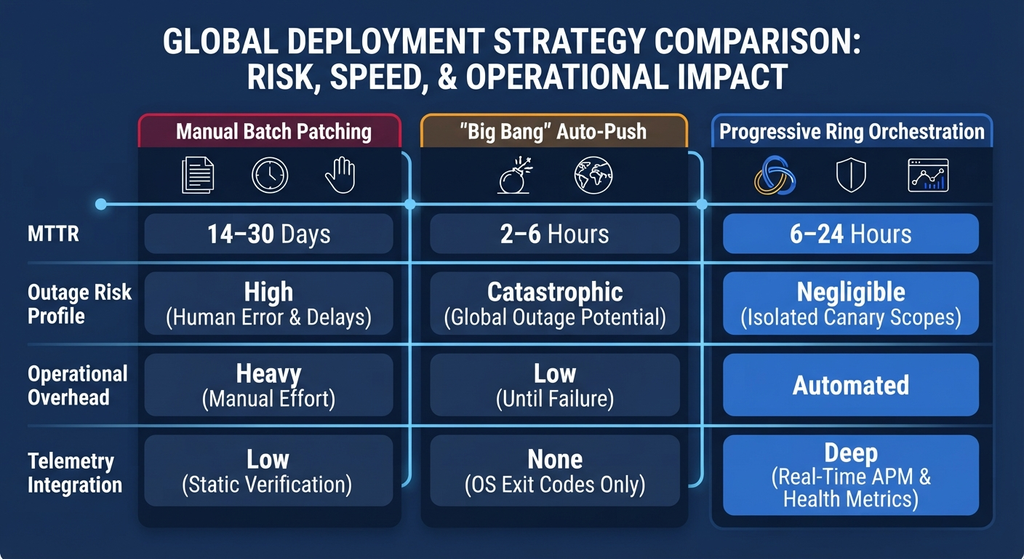
Adopting a progressive ring deployment framework dramatically compresses your remediation timeline while eliminating single-point-of-failure risks during global update cycles.
Actionable Steps to Modernize Your Patch Strategy
Transitioning your enterprise from risky manual maintenance windows to resilient, automated patch orchestration requires a structured approach to culture, process, and tooling.
Audit Infrastructure for High-Availability Readiness
- Identify single points of failure across your global footprint that cannot survive an automated rolling reboot.
- Establish baseline application performance metrics so your automation knows what “healthy” actually looks like.
- Mandate stateless service designs where possible to decouple software updates from active user sessions.
Establish Standardized Deployment Rings
- Categorize all global workloads into clearly defined risk tiers and time-zone clusters.
- Define strict bake times (e.g., 4 to 12 hours) between deployment rings to catch latent memory leaks or configuration drift.
- Ensure canary rings contain representative workload types that mirror actual production traffic.
Integrate Health-Aware Automation
- Configure patch management platforms to listen to your existing observability and logging tools.
- Implement automated traffic-draining scripts that integrate directly with load balancers before any patch executes.
- Regularly test automated rollback scripts in staging environments to verify they work seamlessly during real incidents.

Building an Infrastructure Built for Resilience
Eliminating downtime during critical security updates isn’t simply an administrative challenge—it is an architectural design choice. Organizations that continue to treat security patching as a disruptive, manual event will perpetually find themselves caught between two unacceptable choices: remaining vulnerable to devastating exploits or risking enterprise-wide operational outages. By investing in progressive deployment rings, health-aware automation, and real-time observability, infrastructure leaders can protect global operations without sacrificing continuous business availability.