Executive admins, office managers, and front-desk coordinators handle a chaotic stream of corporate deliveries, vendor supplies, and executive drop-offs every day during the end-of-year rush. Cybercriminals know this and aggressively exploit this operational volume through targeted smishing (SMS phishing) attacks that spoof legitimate carriers like FedEx, UPS, and DHL. When an administrative professional receives a text claiming a package is delayed pending verification, their instinct is to solve the problem instantly to keep operations moving. Upskilling these frontline team members to identify and handle malicious text links is one of the highest-leverage defensive investments an organization can make this season.
Key Takeaways for Business Leadership
- The Vulnerability is Contextual, Not Behavioral: Admins are targeted because their core job function requires handling real-time logistics notifications under tight deadlines.
- Text-Based Phishing (Smishing) Bypass Legacy Controls: Mobile messaging bypasses traditional email security gateways and endpoint filters, arriving directly on personal or corporate mobile devices.
- Standard Verification Trumps Quick Action: Teaching admins to inspect tracking numbers inside official carrier portals—rather than tapping text links—eliminates over 90% of smishing risk.
- Low-Friction Reporting Protocols Save Time: Establishing a zero-blame, single-tap reporting mechanism encourages administrative staff to immediately flag suspicious messages without fear of reprimand.
The Q4 Logistics Crunch: How Smishing Targets Frontline Office Operations
As the final quarter of the year reaches its peak, mid-sized and enterprise offices experience a surge in incoming mail and package deliveries. Client holiday gifts, corporate event supplies, end-of-year hardware refreshes, and last-minute catering orders arrive in rapid succession. In the middle of this operational storm sit your office administrative staff, working diligently to ensure nothing gets delayed or lost in transit.
Threat actors view this seasonal operational spike as a primary entry vector into corporate environments. Rather than attempting to crack hardened perimeter firewalls or sophisticated identity providers, bad actors craft high-frequency, low-friction text messages designed to trick busy administrators into opening malicious URLs on their mobile devices.
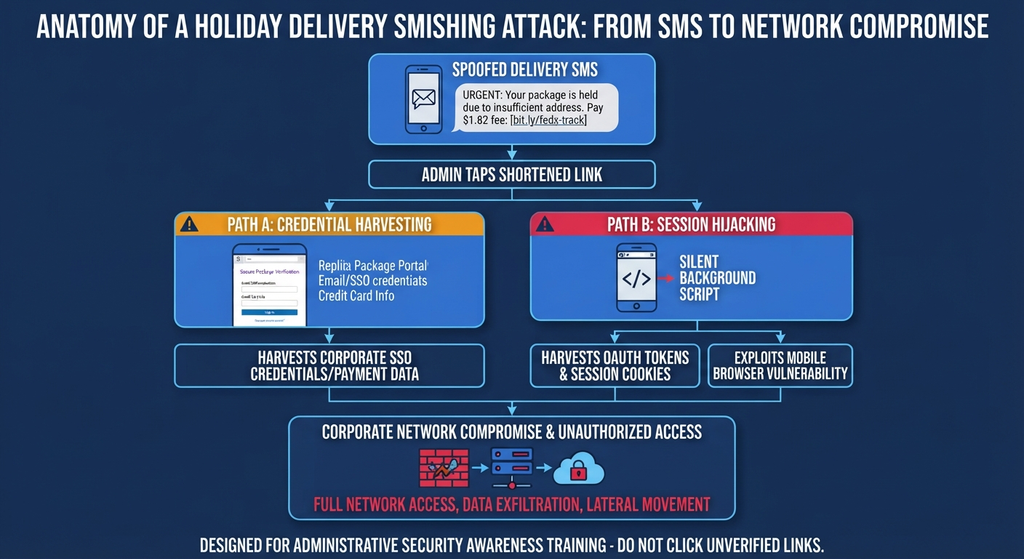
The mechanics of these text messages are straightforward yet effective. An admin receives an SMS stating that a parcel addressed to company executive leadership is held at a regional distribution facility due to an incomplete delivery address or an unpaid $1.50 redelivery fee. The message contains a shortened, urgency-driven link demanding immediate action to avoid package return. Because administrative professionals are wired to be helpful and proactive, tapping the link becomes a natural response.
Why Mobile Text Scams Successfully Bypass Traditional IT Defenses
Securing corporate endpoints has historically focused heavily on desktop workstations, network perimeter firewalls, and enterprise email filters. While modern Secure Email Gateways (SEGs) inspect inbound emails for malicious links and attachment payloads, standard SMS channels operate almost entirely outside this security perimeter.
When an attacker sends a malicious SMS to a company-issued mobile device—or a personal device used under a Bring Your Own Device (BYOD) policy— standard email security tools never inspect the payload. The text arrives directly in the user’s primary SMS app, appearing right next to legitimate notifications from banking partners, identity providers, and two-factor authentication systems.
Anatomy of a Smishing Attack
Modern delivery smishing relies on several common techniques designed to impersonate trusted logistics brands:
- Domain Typosquatting: Attackers register domain names that visually mimic legitimate logistics firms, such as fedx-tracking-update.com or ups-redelivery-notice.site.
- URL Shorteners: Smishing campaigns routinely utilize shorteners or open redirects to obscure the true destination of the web address until the victim clicks.
- Sense of Urgency and Fee Anchoring: By claiming a minimal nominal fee (e.g., $1.82) is required to release an urgent executive delivery, attackers reduce cognitive skepticism and prompt rapid compliance.
- Mobile-Optimized Credential Harvesters: Clicking the link loads a replica carrier page designed specifically for mobile viewports, prompting the admin to sign in using corporate identity credentials or enter corporate credit card information.
Once credentials or session tokens are entered on these spoofed sites, attackers can leverage them to gain unauthorized access to single sign-on (SSO) portals, cloud file repositories, or internal corporate networks.
Building an Actionable Defense: Training Admins to Intercept Smishing
Technical controls like Mobile Device Management (MDM) web filtering provide important baseline protection, but administrative situational awareness remains your primary operational defense against smishing attacks. Training should focus on clear, low-friction habits tailored specifically to administrative workflows.
1. Mandate the “Portal-First” Verification Protocol
Enforce a clear operational policy across administrative teams: Never tap a link inside an unverified text message.
If a text message alerts an admin that a package is delayed or requires updated delivery details, the admin should copy the tracking code provided in the text (or locate the original order confirmation from the sender) and manually navigate to the carrier’s official website or app (e.g., navigating directly to ups.com or fedex.com). Pasting the tracking number directly into the official search portal immediately verifies whether the alert is authentic without opening potentially malicious links.
2. Recognize Visual Indicators of SMS Spoofing
Train administrative teams to quickly spot telltale signs of fraudulent text communications:
- Random or International Sender Numbers: Legitimate commercial carriers send delivery updates via recognized 5-digit or 6-digit SMS short codes, not standard 10-digit consumer phone numbers or international country codes.
- Generic Greetings: Messages that address the receiver generically (“Dear Customer”) rather than referencing specific company names, purchase order numbers, or recipient names.
- Suspicious URL Structures: Any link that does not end in the carrier’s exact, verified root domain (e.g., .com/track) should be treated as untrusted.
3. Establish a Low-Friction Incident Reporting Channel
Administrators must feel comfortable flagging suspicious messages quickly without worrying about causing false alarms or experiencing operational friction.
Set up a dedicated communication channel—such as a internal team channel or a single-click email address—where admins can upload screenshots or forward suspicious texts directly to the IT Security or Helpdesk team. When an admin raises a flag, respond promptly to validate their caution and reinforce a positive security posture.
Action Plan for IT and Operations Leadership
To safeguard administrative workflows against holiday delivery scams, leadership should execute a focused three-step rollout:
- Conduct a Targeted Briefing: Schedule a brief 15-minute alignment session with office managers, executive assistants, and mailroom staff to explain the mechanics of delivery smishing and introduce the “Portal-First” protocol.
- Deploy Mobile Security Controls: Ensure enterprise MDM solutions enforce domain-level filtering on all corporate-owned mobile devices, blocking access to newly registered domains and known phishing sites.
- Audit Vendor Contact Lists: Ensure administrative teams have direct, pre-verified contact details for key vendors and dedicated account managers so they can verify shipment anomalies directly with suppliers rather than relying on automated text notifications.

Strengthening Operational Resilience
Protecting your business during the peak delivery season does not require complex new software suites or disruptive operational changes. By recognizing the unique pressures placed on administrative staff during Q4 and equipping them with clear, practical verification protocols, leadership can eliminate a primary attack vector before it impacts the business. When office admins are empowered to spot and report malicious links instantly, operational efficiency remains high, executive deliveries arrive safely, and corporate networks remain secure throughout the holiday season.