Executive Summary
Public-facing business applications are the front door to your enterprise operations, customer data, and brand reputation. While most organizations invest heavily in patch management and perimeter firewalls, subtle misconfigurations within application settings remain one of the primary vectors for modern cyber breaches. Regular application configuration audits reveal these exposure points before attackers can exploit them, ensuring your security posture matches your modern growth footprint.
Key Takeaways for Business Leadership
- The Invisible Attack Surface: Modern breaches rarely require complex zero-day exploits; they frequently leverage default settings, exposed debug modes, and permissive API configurations.
- Perimeter Security Isn’t Enough: Web application firewalls (WAFs) cannot protect against a system that is intentionally, albeit incorrectly, instructed to grant open access to sensitive endpoints.
- Continuous Drift Control: Configurations shift over time during software updates, developer pushes, and cloud migrations, creating silent security gaps in production environments.
- Audit-Driven Resilience: A structured configuration audit program transforms security from a reactive emergency response into a predictable operational governance model.
The Dangerous Illusion of the Fully Patched Application
Most executive teams rest easy once their IT department confirms all critical software patches are installed. However, running the latest software version offers zero protection if the application itself is configured to leave the back door wide open.
There is a growing disconnect between perceived security investment and actual exposure in modern digital ecosystems. Organizations spend millions on state-of-the-art security software, yet leave public-facing applications vulnerable through simple, overlooked configuration toggles.
Public-facing applications—such as customer portals, web platforms, client dashboards, and public APIs—are constantly scanned by automated malicious bots.
These bots are not looking for complex vulnerabilities that take weeks to engineer.
Instead, they actively search for basic setup oversights, default credentials, exposed storage buckets, and unhardened API endpoints.
When an application’s configuration is flawed, an attacker does not need to break in. They are effectively handed a valid key to your digital infrastructure.
Why Configuration Drift Is Happening Under Your Nose
Software deployment moves faster today than at any point in tech history.
Continuous integration and continuous deployment (CI/CD) pipelines allow engineering teams to push updates, features, and fixes multiple times per day. While this speed drives innovation and customer satisfaction, it introduces a major operational challenge: configuration drift.

Configuration drift occurs when production application settings gradually diverge from established security baselines over time. This drift rarely happens out of negligence; it is almost always a byproduct of speed, operational updates, and temporary troubleshooting fixes that become permanent.
1. The Legacy of “Temporary” Developer Workarounds
During active troubleshooting or emergency hotfixes, engineers frequently enable verbose logging, activate debug modes, or relax access restrictions to identify a bug. Once the fix is deployed, those debug settings are easily forgotten and remain live in public production environments. An active debug mode in a public app can expose full database schemas, secret keys, and internal IP addresses directly to anyone inspecting browser traffic.
2. Cloud Migration and Shadow Microservices
As organizations scale, applications rely on webhooks, third-party microservices, and external storage assets. Each integration adds dozens of unique configuration files, permission policies, and environment variables. Without centralized auditing, teams lose visibility over which public endpoints are connected to backend corporate databases.
3. Default Settings Left Untouched
Many enterprise SaaS platforms, web frameworks, and application stacks ship with permissive default configurations designed for easy initial setup. These defaults prioritize developer convenience over corporate security out of the box. If your team does not actively harden these settings upon deployment, your application operates with publicly accessible administrative panels, default file paths, and unencrypted parameters.
Mapping the Risk Spectrum in Public-Facing Applications
Understanding where these vulnerabilities live is the first step toward securing your public footprint. Different application configuration failures present varying levels of risk to enterprise operations.
| Vulnerability Domain | Common Misconfiguration Example | Business Impact | Risk Level |
| API Access Control | Overly permissive Cross-Origin Resource Sharing (CORS) rules | Unauthorized third-party sites reading sensitive user data | Critical |
| Session Management | Missing Secure, HttpOnly, or SameSite flags on session cookies | Interception of administrative sessions via cross-site scripting | High |
| Error Handling | Raw application traces and database errors displayed publicly | System architecture disclosure giving attackers explicit blueprint | Medium |
| Authentication Flow | Unrestricted login endpoints without rate limiting or MFA enforcement | Automated credential stuffing attacks and brute-force account takeovers | Critical |
| Data Storage Asset Access | Publicly readable Amazon S3 buckets or storage blobs containing media | Direct data leakage and regulatory compliance violations | High |
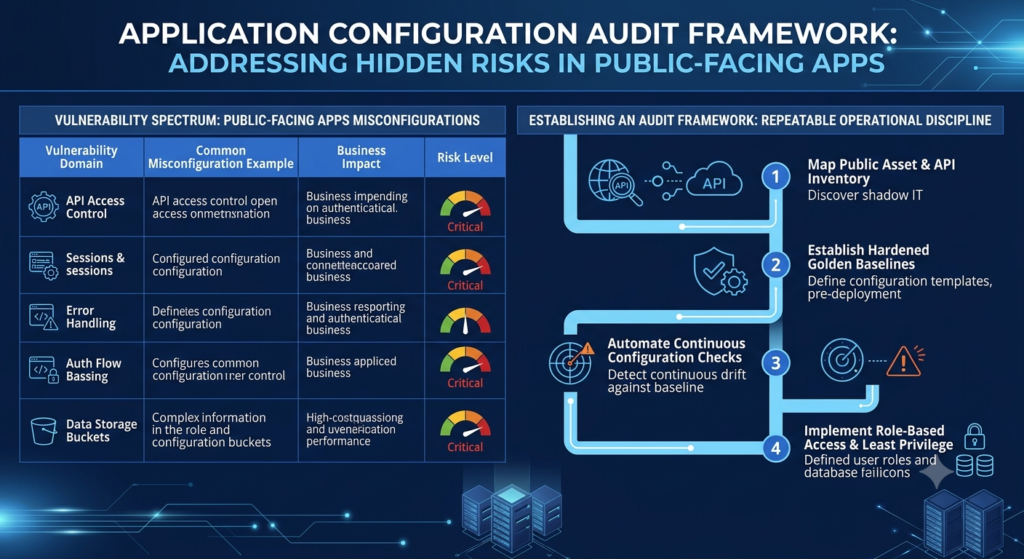
The matrix above illustrates how minor technical oversights cascade into high-level enterprise risks.
Notice that none of these vulnerabilities rely on broken software code; every single one is the direct result of a misconfigured parameter within a functioning application.
The Hidden Costs of Ignoring Application Settings
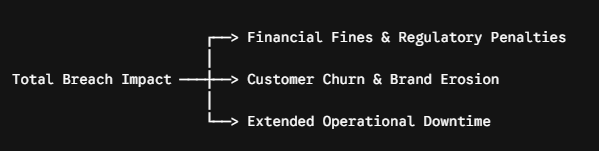
When a configuration breach occurs, executive leadership often faces compounding organizational damage.
The immediate technical remediation is usually the smallest expense incurred during a incident response cycle.
Unplanned Downtime and Operational Stoppage
Remediating an active configuration exploit often requires taking critical public apps offline to rewrite permission policies and re-architect endpoint access. Every hour your public app is down, business transactions freeze and customer satisfaction plunges.
Regulatory and Compliance Penalties
Frameworks such as GDPR, HIPAA, and PCI-DSS explicitly mandate the secure configuration of systems storing sensitive personal or financial information. Failing to conduct documented audits leaves your company exposed to severe regulatory fines for failing to maintain standard due care.
Loss of Customer Trust
B2B clients and consumers expect their data to be shielded by institutional-grade controls.
A breach caused by something as basic as an unauthenticated admin portal destroys brand credibility and undermines client confidence overnight.
Establishing an Effective Application Configuration Audit Framework
Securing your application ecosystem does not mean slowing down your business development teams.
Instead, it requires establishing an automated, repeatable auditing framework that continuously validates application settings against security standards.
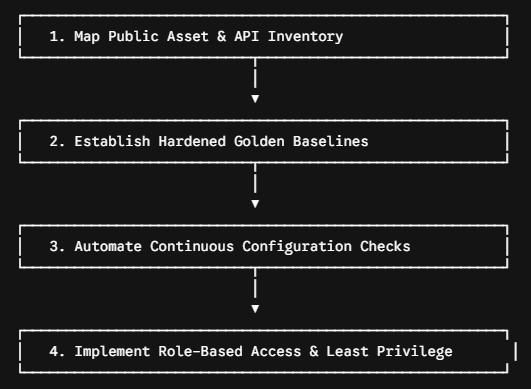
Step 1: Discover and Map All Public Assets
You cannot secure what you do not know exists. Conduct a comprehensive inventory of all public-facing applications, subdomains, legacy staging sites, and public API gateways. Pay special attention to shadow IT assets created by individual business units outside of standard IT oversight.
Step 2: Define Hardened Golden Baselines
Establish explicit configuration templates for every technology stack used within your business operations. These baselines should define strict rules for header security, token expiration, cookie attributes, error handling, and encryption protocols. Ensure that these baseline requirements are embedded directly into your software deployment pipelines.
Step 3: Implement Continuous Automated Auditing
Manual periodic audits are vital, but they only provide a point-in-time snapshot of your security posture. Integrate automated configuration management tools that scan your public applications continuously for policy deviations. When a setting drifts away from your established baseline, your team should receive an immediate automated alert to remediate the exposure before it can be exploited.
Step 4: Enforce Least Privilege for App Connections
Review how your public applications communicate with internal backend databases and secondary microservices. Ensure that applications use service accounts restricted strictly to the permissions required for their specific function. If a public application is compromised, strict access controls prevent an attacker from pivoting deeper into your core corporate network.
Bridging the Gap Between Executive Leadership and Technical Teams
Maintaining a secure application footprint requires close alignment between business leadership and technology managers.
Security cannot be treated purely as an operational task delegated away without strategic oversight.
Leadership must provide the mandate, resources, and accountability needed to make application configuration audits a routine business discipline. By integrating configuration audits into your standard governance risk and compliance (GRC) workflow, you turn security into a competitive advantage.
Clients prefer to do business with organizations that can demonstrably prove their digital applications are hardened, monitored, and resilient against modern cyber threats.