Executive Summary
When a cyber breach occurs, human response time is no longer fast enough to prevent widespread damage. Modern automated incident response flips the script, shifting security from a reactive scramble to a real-time containment strategy. By leveraging intelligent network protocols, businesses can isolate threats within seconds, minimizing data loss and operational downtime before a human analyst even blinks.
The Dangerous Illusion of the “Fast” Human Response
In mid-sized business leadership, there is a common, comforting misconception. Many executives believe that having a dedicated IT team on call means their network is secure.
The reality? Cyberattacks don’t operate on human schedules, and they certainly don’t move at human speed.
When ransomware or a malicious payload infiltrates a network, it spreads laterally in milliseconds. Relying on an engineer to wake up at 3:00 AM, read an alert, log into a dashboard, and manually isolate a server is a recipe for disaster. By the time those manual steps are taken, the breach has already escalated into a full-scale operational crisis.
The technical gap isn’t a lack of skill; it’s a lack of velocity. Traditional security models rely on a chain of human commands that creates a dangerous window of vulnerability. Closing this gap requires shifting the responsibility of immediate containment from human hands to intelligent software.
The Pillars of Real-Time Containment
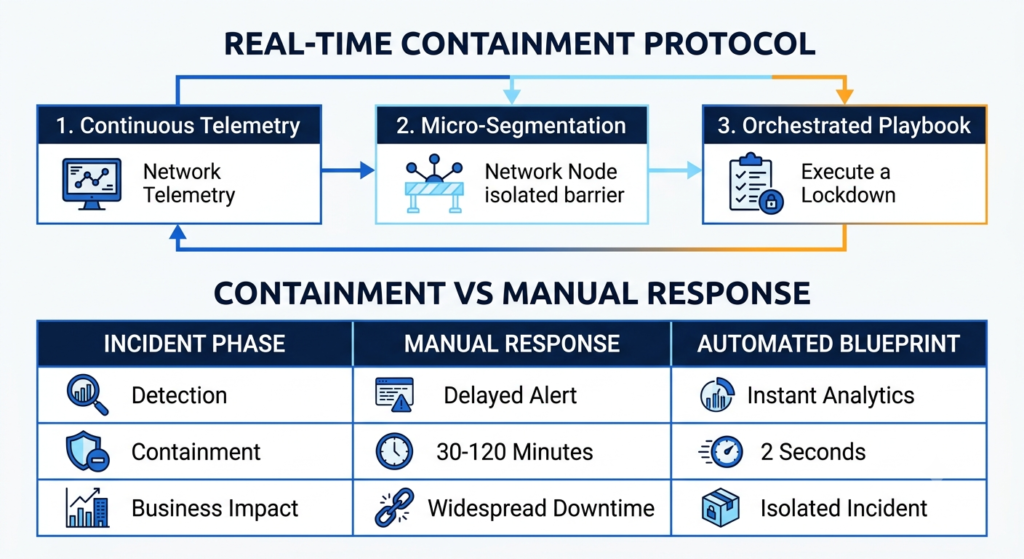
To stop a digital fire from consuming the entire enterprise, the network infrastructure must be capable of self-defense. Automated incident response relies on three core capabilities to neutralize threats instantly.
1. Continuous Behavioral Telemetry
Instead of waiting for known malware signatures, modern security systems monitor the baseline behavior of the entire network. If a user account suddenly attempts to download 50 gigabytes of encrypted files at midnight, the system flags the anomaly instantly.
2. Immediate Micro-Segmentation
Once a threat is identified, the network doesn’t wait for permission to act. It dynamically alters its own architecture, isolating the compromised device or subnet from the rest of the corporate ecosystem.
3. Orchestrated Playbooks
Automated platforms execute pre-configured playbooks that orchestrate actions across different security tools. The firewall, endpoint protection, and identity management systems work in perfect synchronization to lock down the threat.
Anatomy of an Automated Containment vs. Manual Response
To understand the business impact, we have to look at how a crisis plays out under both paradigms. The difference between minutes and seconds represents the boundary between a minor IT anomaly and a catastrophic business disruption.
| Incident Phase | Traditional Manual Response | Automated Blueprint Execution |
| Infiltration | Malicious payload executes on a local workstation. | Malicious payload executes on a local workstation. |
| Detection | Threat goes unnoticed until a server triggers a high-level alert. | Behavioral analytics flag anomalous lateral movement instantly. |
| Initial Action | IT support is paged; triage begins as the infection spreads. | System revokes device credentials and isolates the host port. |
| Containment | Engineers manually disconnect servers (30 to 120 minutes). | Micro-segmentation confines the threat to one device (2 seconds). |
| Business Impact | Widespread downtime, data exfiltration, reputational damage. | Isolated incident, uninterrupted operations, clean audit trail. |
The technical choreography required to achieve this level of speed involves deep integration between your security information tools and your actual network hardware. When an Endpoint Detection and Response (EDR) agent detects a breach, it instantly signals the network switches and wireless controllers to quarantine the affected machine.
Blueprinting Your Automated Defense Strategy
Transitioning to an automated containment model doesn’t mean replacing your existing IT team. It means empowering them. Instead of fighting fires, they can focus on forensics and systemic improvements.
Here is how leadership can begin driving this architectural shift:
- Audit Your Time-to-Containment: Ask your technical team for an honest assessment of how long it takes to fully isolate a compromised device on a weekend.
- Implement Identity-Centric Micro-Segmentation: Ensure your network structure is granular enough that a breach in marketing cannot migrate to your financial databases.
- Deploy Smart Playbooks Gradually: Start by automating low-risk, high-certainty actions, such as quarantining a device when a known ransomware strain is detected.
Insist on Cross-Tool Integration: Stop purchasing isolated security tools. Your firewall, endpoints, and cloud environments must speak the same language in real time.

Moving to an automated incident response framework is no longer a luxury reserved for global enterprises. For mid-sized businesses, it is a foundational requirement for operational resilience.
When your network is capable of containing breaches in real time, a cyberattack ceases to be an existential threat and becomes a quietly managed event. Security is not about being bulletproof; it is about being resilient enough to neutralize the threat before it impacts your bottom line.
As you look at your current technology roadmap, consider how your defenses handle pressure when no one is watching. If a sophisticated security breach hits your network tonight at midnight, will your infrastructure defend itself instantly, or will it wait for a human to log in?