Executive Summary
When software acquisition becomes decentralized, organizations quietly accumulate a costly, dangerous layer of invisible technology. This strategic briefing outlines how unchecked application growth—commonly known as “tool sprawl”—inflates software budgets and introduces unmanaged security vulnerabilities. By executing a structured audit, rationalizing redundant platforms, and centralizing procurement, leadership can simultaneously reclaim capital and eliminate critical data blindspots.
The Silent Creep of the Modern Tech Stack
It starts innocently enough. A marketing team needs a specialized analytics tool. Sales prefers a specific CRM add-on. Human resources adopts a standalone onboarding platform.
Before long, a mid-sized business is running dozens of SaaS applications, many of which bypass IT procurement entirely.
This is the reality of tool sprawl. It is a modern operational paradox: in the pursuit of productivity, organizations have fragmented their environments, creating a chaotic web of logins, overlapping capabilities, and unvetted data repositories.
The disconnect is stark. While executive leadership believes they have a clear handle on operational expenses and digital risk, a vast layer of “Shadow IT” often operates completely beneath the corporate radar.
The Double-Edged Sword: Financial Drain and Security Blindspots
Unchecked application growth does not just complicate workflows; it actively erodes a company’s bottom line and compromises its defense posture. This challenge persists because SaaS acquisition has become friction-free, allowing any department with a credit card to introduce new software into the corporate ecosystem.
The Financial Leak: Paying for the Same Feature Twice
When software purchasing is siloed, departments independently buy tools that perform nearly identical functions.
A company might simultaneously pay for premium tiers of Zoom, Microsoft Teams, and Webex across different teams.
Furthermore, businesses frequently pay for unused or underutilized user licenses, locking capital into forgotten subscriptions that automatically renew year after year.
The Security Void: What IT Can’t See, It Can’t Protect
Every single application connected to a corporate network represents an entry point for potential adversaries.
When employees adopt applications without IT’s knowledge, those platforms miss out on critical security protocols, such as Single Sign-On (SSO) integration and Multi-Factor Authentication (MFA).
If an off-boarded employee retains access to an unmapped third-party app, sensitive corporate data remains exposed, completely outside the purview of the security team.
Evaluating the Impact: Operational vs. Fragmented Environments
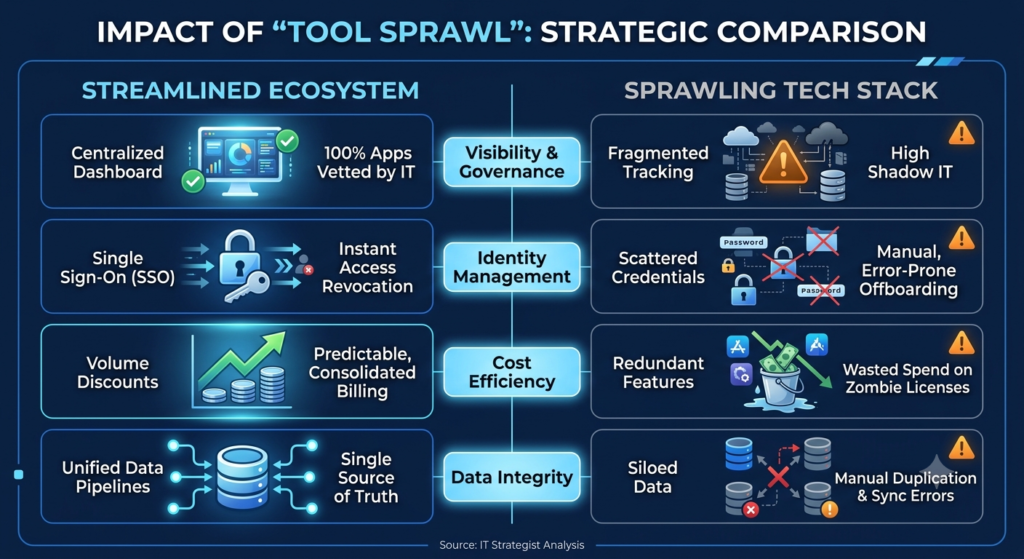
To effectively manage an ecosystem, leadership must understand the practical differences between a streamlined tech stack and an unmanaged, sprawling environment.
| Operational Focus | The Streamlined Ecosystem | The Sprawling Tech Stack |
| Visibility & Governance | Centralized dashboard; 100% of apps vetted by IT. | Fragmented tracking; high percentage of Shadow IT. |
| Identity Management | Universal SSO; instant access revocation upon offboarding. | Scattered credentials; manual, error-prone offboarding. |
| Cost Efficiency | Volume discounts; predictable, consolidated billing. | Redundant features; wasted spend on zombie licenses. |
| Data Integrity | Unified data pipelines; single source of truth. | Siloed data; manual duplication and sync errors. |
The breakdown above highlights how consolidation transforms a chaotic environment into a predictable, highly defensible asset. Reducing the sheer volume of entry points directly minimizes the attack surface while freeing up valuable operational budget.
A Strategic Framework for Technical Consolidation
Regaining control of your digital infrastructure requires a systematic approach rather than an overnight purge. The goal is not to strip teams of the tools they genuinely need, but to optimize how those tools are discovered, evaluated, and managed.
1. Execute an Automated Discovery Audit
Do not rely on manual surveys or spreadsheets to find your apps. People forget what they signed up for.
- Analyze Financial Records: Review corporate credit card statements and expense reports over the trailing 12 months for recurring software anomalies.
- Leverage Network Logs: Utilize cloud access security brokers (CASBs) or identity providers to monitor which external applications are actively receiving corporate data traffic.
2. Categorize and Rationalize Capabilities
Once you have a complete inventory, map every tool to its core business function.
Group your applications into functional buckets such as Project Management, File Storage, Communication, and Analytics.
Identify the overlaps. If you discover three different whiteboarding tools across four departments, it is time to mandate a single, corporate standard.
3. Establish a Formal Procurement Gate
Prevent future sprawl by changing the way software enters your business moving forward.
- Define Clear Ownership: Ensure all technology purchases, regardless of size, require a security and architecture review by the IT department before execution.
- Implement Low-Code/No-Code Standards: Encourage teams to leverage existing enterprise platforms (like Microsoft 365 or Google Workspace) to build custom workflows before seeking external, niche applications.
Governance Diagnostic for Leadership
Before approving the next IT budget or security roadmap, take a moment to evaluate the current state of your corporate infrastructure with these diagnostic questions:
- How many unique SaaS platforms are currently processing our corporate data, and what percentage of them are integrated into our central identity provider?
- Are we currently paying for overlapping capabilities across different departments because of decentralized purchasing?
- When an employee leaves the company tomorrow, can we confidently guarantee their access is revoked across every single application they used?

Reclaiming Control
Streamlining tool sprawl is not a one-time cost-cutting exercise; it is a foundational component of modern business governance. By aggressively reductionizing redundant software, leadership can eliminate dangerous cybersecurity blindspots while simultaneously driving down unnecessary IT expenditures. True operational agility comes from a clean, intentional tech stack where every application has a defined purpose, a clear owner, and a secured perimeter.