Executive Summary:
Audio deepfakes powered by generative AI have transformed business email compromise (BEC) into highly convincing, multi-channel executive impersonation attacks. By synthesizing just seconds of public voice data, cybercriminals can clone C-suite voices, place live phone calls to finance personnel, and bypass traditional security perimeter controls to authorize multimillion-dollar wire transfers. Organizations must evolve beyond legacy trust models by embedding out-of-band cryptographic verification, updating dual-authorization policies for financial movement, and training staff to recognize real-time voice synthesis anomalies.
Key Takeaways for Business Leaders
- The New Threat Vector: Audio cloning technology allows attackers to execute real-time, bi-directional phone conversations using a synthesized voice that perfectly matches an executive’s pitch, tone, and speech cadence.
- The Exploited Gap: Traditional financial controls rely heavily on “voice authorization” as a trusted secondary factor. Synthetic voice attacks exploit this human trust without breaching a single network firewall.
- Immediate Defense Strategy: Implement strict out-of-band verification protocols (such as secondary digital challenge-response tokens or pre-agreed code phrases) that make verbal wire approvals obsolete on their own.
The Illusion of Voice Trust in the Enterprise
For decades, the human voice served as the ultimate corporate verification mechanism. When a complex or high-value transaction hit a roadblock, a quick phone call to the CFO or CEO was all it took to clear the path. “I spoke with them directly” was the gold standard of verification in treasury departments, finance teams, and executive offices worldwide.
That operational certainty has vanished.
Cybercriminals have systematically dismantled voice-based trust by pairing traditional social engineering with advanced generative AI. Instead of relying solely on compromised email accounts to request fraudulent wire transfers, bad actors now pick up the phone. They use voice clones capable of replicating an executive’s exact cadence, accent, and conversational quirks in real time. This isn’t a futuristic threat scenario—it is a present-day operational reality. Organizations of all sizes are discovering that their most sensitive financial workflows contain a critical vulnerability: an over-reliance on voice recognition as an authentication factor.
The Mechanics of Voice Cloning: How Attackers Build an Executive Synthetic Voice
To defend against voice impersonation attacks, business leaders must understand the mechanics behind synthetic audio generation. Cybercriminals do not need access to classified corporate servers or expensive recording studios to clone an executive’s voice. The entire process relies on publicly accessible data and readily available commercial tools.
High-Volume Data Harvesting from Public Media
Executives naturally leave behind a significant acoustic footprint. Earnings calls, keynotes, podcast appearances, panel discussions, and YouTube interviews provide hours of high-quality audio. Attackers harvest these recordings and process them through automated audio-cleaning algorithms. They strip away background noise, echo, and overlapping speech to isolate clean voice samples.
Minimal Audio Sampling and Model Training
Modern deep learning models no longer require hours of training data to achieve high fidelity. Advanced neural voice cloning architectures can generate a convincing voice replica using as little as three to five seconds of clear audio. These models map the unique acoustic characteristics of the speaker—including formant frequencies, vocal resonance, breath patterns, and regional inflections. Once the base model is generated, it can convert text to speech or perform voice-to-voice translation in near-real-time with minimal latency.
Multi-Channel Social Engineering Execution
The cloned voice is rarely used in isolation. It is typically deployed as the final authorization step in a carefully orchestrated, multi-channel social engineering campaign. The attack usually begins with a compromised email account or a spoofed domain that establishes a sense of urgency—such as an off-the-books acquisition or a regulatory deadline. When the targeted finance manager pauses or asks for confirmation, the attacker executes a phone call using the cloned voice to confirm the email instructions and push the transfer through.
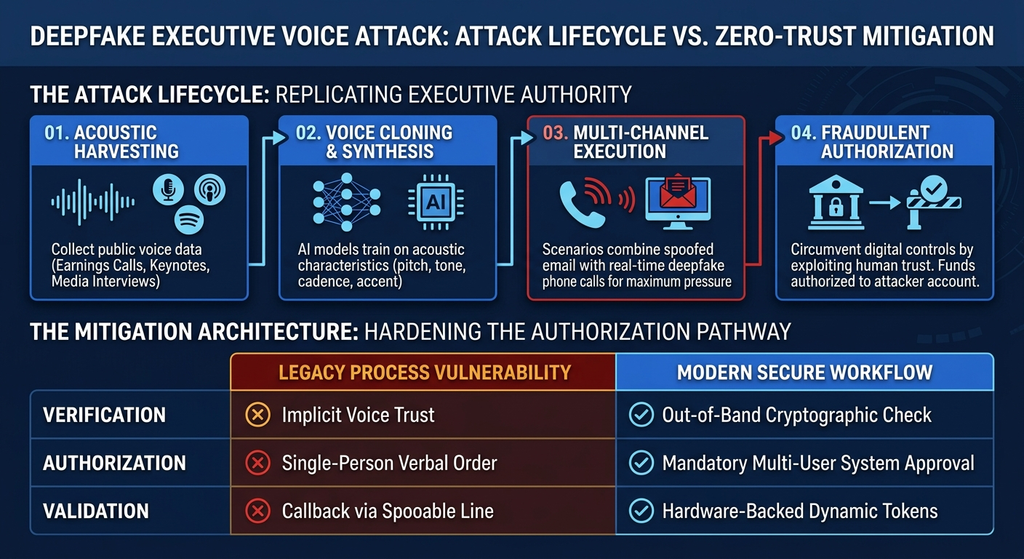
The transaction flow above illustrates how synthetic voice attacks exploit the gap between digital security and human operational processes. While your technical stack—firewalls, endpoint detection, and secure email gateways—remains unbreached, the attacker circumvents every digital control by targeting the human authorization step.
Why Legacy Financial Controls Fail Against Generative AI
Most corporate governance frameworks were built around a simple threat model: prevent unauthorized access to systems. However, voice deepfake attacks do not attempt to hack software; they hack the human trust layer that oversees the software.
The Breakdown of “Callback” Protocols
Many financial policies require employees to perform a “callback” to confirm wire instructions received via email. Unfortunately, these policies often fall short in practice. If the employee calls the phone number provided in the fraudulent email signature or an incoming spoofed caller ID, they land directly back on the attacker’s line. Hearing the executive’s voice on the other end creates immediate cognitive closure, causing the employee to skip secondary checks.
Exploitation of Executive Authority and Urgency
Deepfake phone calls rely heavily on psychological pressure. Attackers deliberately structure scenarios around extreme urgency, confidentiality, or high-stakes pressure. An employee receiving a direct call from their CEO during a supposed M&A negotiation feels immense pressure to comply quickly. The familiar sound of the leader’s voice short-circuits their natural instinct to question unusual procedures or verify details through formal channels.
The Limitations of Biometric Voice Authentication
Organizations that have adopted voice biometrics for account access or phone banking face unique operational risks. Traditional voice biometrics analyze frequency patterns and pitch to verify identity.
Advanced deepfake models are explicitly designed to match these identical acoustic signatures. Without specialized liveness detection—which analyzes micro-acoustic anomalies, room acoustics, and dynamic phonetic responses—standard voice biometric systems can be fooled by high-fidelity synthetic audio streams.
Modernizing Authorization Controls: A Framework for Leadership
Defending against synthetic executive voice impersonation requires a shift in how organizations conceptualize authorization. You cannot train employees to reliably spot deepfakes by ear alone—the technology improves too quickly, and phone line compression masks subtle audio artifacts. Instead, you must eliminate voice recognition as a standalone authorization factor and implement process-level controls that remain secure even when a voice is perfectly cloned.
1. Mandate Out-of-Band Cryptographic Verification
Never rely on a phone call alone to authorize financial transactions, credential resets, or sensitive data disclosures. Establish strict out-of-band verification mechanisms using cryptographically secure tools.
- Multi-Factor Approval via Dedicated Apps: Require all wire approvals to pass through a secure enterprise app requiring hardware-backed tokens or biometrics tied to an enrolled device.
- Pre-Agreed Dynamic Code Phrases: For verbal communications, implement a rotating code phrase framework or secondary channel confirmation (e.g., confirming via an internal encrypted chat app on an enrolled corporate phone).
2. Redefine Dual-Authorization Financial Thresholds
Review your company’s payment authorization matrix and eliminate single-person approval pathways above strict financial limits.
- Enforce System-Level Dual Approvals: Ensure your banking portals require two independent system logins from separate authorized users to release funds, regardless of executive verbal instructions.
- Remove “Executive Overrides”: Explicitly train finance personnel that no executive—regardless of rank—has the authority to bypass established payment verification protocols over the phone.
3. Conduct Realistic Scenario-Based Simulation Training
Standard security awareness training often focuses on identifying suspicious email links. Update your training programs to reflect modern, multi-channel threats.
- Simulate Deepfake Scenarios: Run controlled social engineering tests that combine email context with simulated phone follow-ups to teach employees how urgent verbal requests feel in practice.
- Normalize Procedural Friction: Foster a corporate culture where double-checking an executive’s request through secondary formal channels is rewarded rather than penalized as slow or unhelpful.
Resiliency in the Age of Synthetic Media
Generative AI has permanently changed the perimeter of business technology. As voice cloning capabilities become faster, cheaper, and more accessible, the assumption that an incoming phone call represents a verified human identity is no longer valid. Protecting your organization from corporate deepfakes does not require complex new technology investments at every layer. Instead, it demands a fundamental shift in operational protocol: replacing implicit trust with explicit verification. By hardening your financial workflows, enforcing strict dual-authorization controls, and empowering your team to question unverified verbal requests, you build a resilient enterprise capable of neutralizing synthetic threats before funds leave your accounts.