Executive Summary: Internal IT departments are increasingly buried under routine help desk tickets, compliance maintenance, and daily firefighting. This constant operational pressure leaves high-impact, strategic infrastructure projects indefinitely delayed. A Co-Managed IT model allows mid-sized businesses to retain their in-house team’s deep company knowledge while augmenting them with a Managed Service Provider (MSP) for specialized expertise, extra hands, and dedicated project bandwidth. The result? Backlogs clear faster, core staff avoid burnout, and modern infrastructure goals are actually met.
The Silent Growth Killer: The Perpetual Infrastructure Backlog
Your internal IT team is likely running on a treadmill that never stops.
They know the server infrastructure needs a redesign, the network stack requires an upgrade, and the cloud migration was supposed to finish two quarters ago.
Yet, every morning brings a fresh wave of password resets, faulty software updates, hardware failures, and user onboarding requests.
When immediate operational needs constantly eclipse long-term strategy, critical infrastructure projects fall behind.
This issue isn’t caused by a lack of talent or poor work ethic. It is simply a capacity problem.
Mid-sized organizations often ask a small team of generalists to manage both high-level architecture and low-level daily support simultaneously.
Eventually, the strategic backlog grows so large that system performance degrades, security vulnerabilities compound, and competitive advantage slips away.
Why Internal Teams Get Trapped in Maintenance Mode
Understanding why the backlog exists in the first place is the first step toward fixing it.
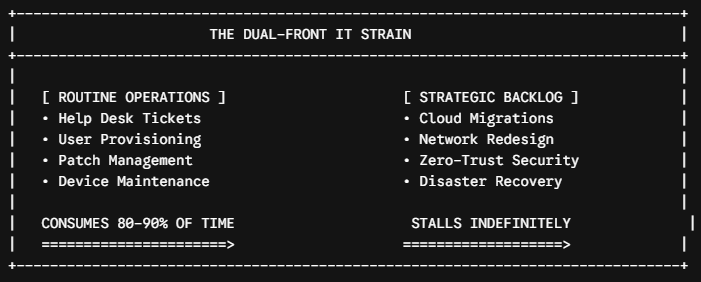
The Dilemma
When a core network switch drops or a critical application crashes, project work stops immediately.
Urgent issues always trump important ones.
Because routine disruptions are unpredictable, project momentum is repeatedly lost, forcing engineers to constantly context-switch.
The Specialization Gap
Modern IT infrastructure demands hyper-specialized skills across cybersecurity, cloud architecture, compliance, and unified communications. Expecting a small internal team to possess enterprise-level expertise in every single domain is unrealistic and costly.
When a complex project hits an area outside the team’s primary skill set, progress stalls while they scramble to research and upskill on the fly.
Talent Burnout and Retention Risks
Top-tier IT professionals want to build, innovate, and modernize enterprise environments.
When they spend 90% of their working hours handling basic end-user tickets, job satisfaction plummets. This environment breeds burnout, leading to high turnover that resets project timelines all over again.
The Co-Managed Solution: A True Hybrid Force Multiplier
Co-Managed IT fundamentally changes this dynamic by breaking the false choice between replacing internal staff or letting projects sit dormant.
Rather than outsourcing everything, leadership introduces an MSP partner to co-own operational responsibilities based on internal strengths and gaps.
| Operational Area | Purely Internal Model | Traditional Outsourcing | Co-Managed IT Model |
| Tier 1–2 Support | Internal team handles all tickets | Third-party handles all tickets | Shared or offloaded to MSP |
| Infrastructure Projects | Severely backlogged due to time | Handed off entirely with minimal context | Joint execution with specialized MSP assets |
| Tooling & Monitoring | Capital-intensive internal spend | Vendor-owned proprietary stack | Enterprise tools shared with internal team |
| Strategic Direction | Internal team (when time allows) | Vendor-driven agenda | Internal team leads, MSP supports |
| Institutional Knowledge | High retention within company | Lost to outside third party | Fully preserved internally |
By deploying enterprise-grade ticketing systems, central monitoring tools, and dedicated engineering resources, a co-managed model directly addresses capacity bottlenecks.
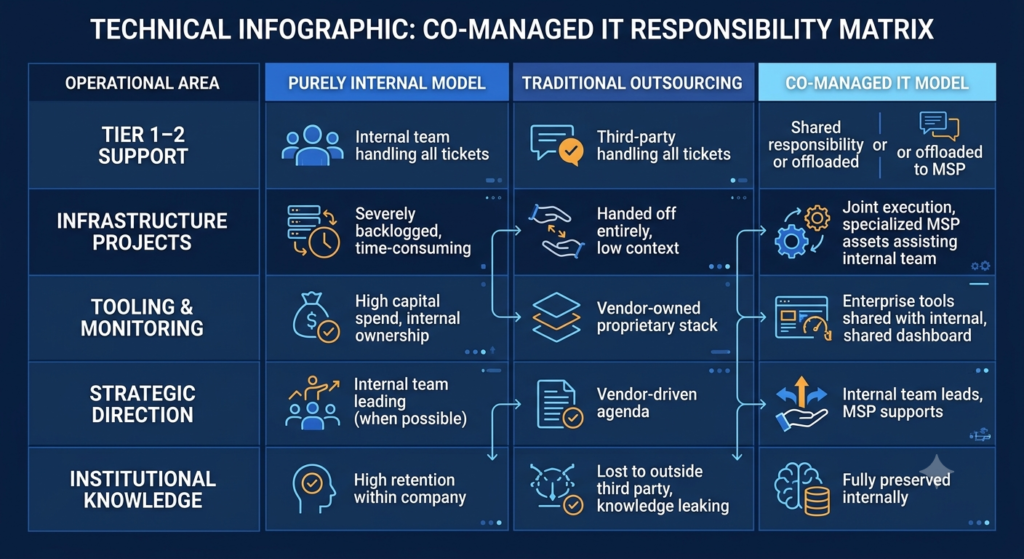
The chart above illustrates how responsibilities shift seamlessly under a co-managed approach, allowing internal staff to retain ownership of business goals while gaining operational scale.
Strategic Blueprint: Crushing Backlogged Projects Step-by-Step
Moving from an overburdened state to an agile infrastructure engine requires a deliberate rollout.
1. Identify the Optimal Division of Labor
Decide where your internal team provides the highest value to the organization.
Often, this means keeping business logic, proprietary application management, and internal stakeholder relationships in-house. Routine tasks like off-hours patching, baseline monitoring, or initial help desk triage can be offloaded to the MSP partner.
Alternatively, you can keep daily support in-house while handing complex, one-off infrastructure overhauls to the MSP’s specialized project engineers.
2. Standardize on Shared Toolsets
Efficiency relies on unified visibility across both organizations.
A co-managed framework provides your internal team access to enterprise-grade Professional Services Automation (PSA) and Remote Monitoring and Management (RMM) platforms.
Both teams view the same tickets, monitor the same network endpoints, and track the same project milestones in real time.
This shared environment eliminates communication silos and ensures accountability.
3. Tackle Infrastructure Projects in Sprints
With daily support stable and offloaded, project backlogs can be organized into manageable, high-priority sprints. Whether executing a cloud migration, implementing a zero-trust network structure, or refreshing storage arrays, joint teams work in tandem.
The MSP provides specialized technical architects and supplemental labor, while the internal team provides institutional context and oversight.
Projects that previously languished for months can be completed in weeks.
Immediate Diagnostic Checklist for Leadership
If you aren’t sure whether a co-managed model fits your current environment, work through these diagnostic questions with your technology leaders:
- Is your internal team routinely missing project deadlines due to daily help desk interruptions?
- Are major security upgrades or cloud initiatives stalled because your staff lacks hyper-specific technical certifications?
- Is high turnover impacting your IT department due to frustration over tedious, repetitive tasks?
- Does your team lack access to enterprise-level management and security platforms due to licensing costs?
If you answered yes to two or more of these questions, your infrastructure backlog is likely impacting overall business performance.
Taking Control of Your Infrastructure Roadmap
Partnering with an MSP through a co-managed framework isn’t about replacing your internal team—it’s about empowering them.
It gives your existing staff the tools, bandwidth, and enterprise backing necessary to step out of reactive firefighting and focus on business growth.