Executive Summary & Key Takeaways
The modern holiday shopping season is no longer just a test of inventory and marketing strategy; it is an intense trial of digital infrastructure resilience. As peak Q4 traffic surges, Distributed Denial of Service (DDoS) attacks increasingly target the critical digital connective tissue between e-commerce storefronts, supply chain portals, and logistics fulfillment software. A single outage during Black Friday weekend can halt warehouse picking, disrupt API integrations with carriers, and destroy customer trust in a matter of minutes.
- DDoS is No Longer Just Volumetric: Modern holiday cyber threats have evolved past simple bandwidth exhaustion to sophisticated Layer 7 Application and API-level floods that bypass traditional perimeter defenses.
- Supply Chain Interdependency creates Vulnerability: An attack on a middle-mile logistics gateway or third-party API can paralyze your operations just as effectively as a direct hit on your main storefront.
- Proactive Orchestration is Mandatory: Defending against Q4 threats requires automated rate limiting, behavior-based anomaly detection, and pre-tested failover protocols executed long before peak volume hits.
The Q4 Pressure Cooker: Where Traffic Spikes Meet Targeted Disruption
Every year, the Q4 shopping rush presents an unprecedented commercial opportunity. Yet, beneath the surface of record-breaking sales numbers lies a fragile operational reality: your digital infrastructure is forced to operate at maximum stress levels for days on end.
For threat actors, this seasonal concentration of revenue creates the ultimate leverage point. A DDoS attack launched during an ordinary Tuesday in May might be a minor operational annoyance, but that exact same attack on Black Friday becomes an existential business threat. Cybercriminals know that during peak season, every minute of downtime directly translates to thousands or millions of dollars in lost gross merchandise value (GMV).
What makes the modern Black Friday landscape particularly dangerous is the sheer interconnectedness of modern commerce platforms. Your public-facing storefront does not operate in a vacuum. It relies on a sprawling ecosystem of inventory databases, third-party payment gateways, warehouse management systems (WMS), and logistics API endpoints. When bad actors target these operational dependencies, they don’t just take down a website—they bring the entire delivery engine to a screeching halt.
Deconstructing the Q4 Threat: How Attack Vectors Target Logistics Infrastructure
To build a resilient defense, enterprise leaders must first understand that Q4 DDoS attacks have shifted away from crude brute-force tactics toward highly intelligent, multi-layered assaults designed to exploit application logic and API architectures.
Application Layer (Layer 7) Sabotage
While classic Layer 3 and Layer 4 attacks attempt to saturate your network bandwidth with raw volumetric traffic, Layer 7 attacks target the server resources running your web applications. During peak sales, attackers launch low-and-slow HTTP GET/POST floods that mimic legitimate user browsing, checkout requests, or site searches. Because these requests look authentic, standard firewall rules often fail to flag them, causing backend database pools to deplete and legitimate shoppers to experience timeout errors.
Logistics API & Middle-Mile Interruption
Logistics software relies heavily on real-time API polling for inventory lookups, shipping rate calculations, and label generation. Threat actors deliberately target these underlying API endpoints with high-frequency bot calls. If your logistics software cannot process carrier requests or send order data to fulfillment centers, warehouse staff are left blind, order processing backlogs rapidly build up, and shipping SLAs are missed—even if your main homepage appears completely operational.
Extortion & Operational Sabotage
Not all Q4 DDoS campaigns are driven by simple hacktivism or competitive disruption. Cyber Extortion (Ransom DDoS) has grown sharply, where attackers launch a short “demonstration” flood followed by a ransom demand to refrain from attacking during peak shopping hours. Additionally, bad actors use automated botnets to hoard inventory in digital carts (inventory denial), straining backend logistics systems without ever completing a transaction.
Structural Anatomy of a Holiday DDoS Mitigation Stack
Understanding how traffic flows through protective layers allows technical teams to stop malicious floods before they reach backend application code or logistics databases.
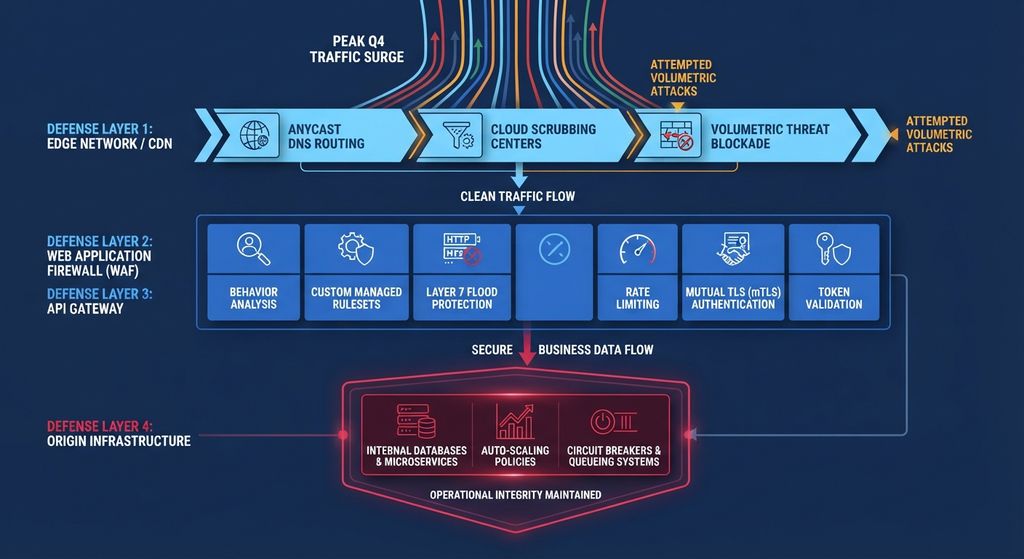
The table above illustrates the tiered defensive model required to insulate critical business infrastructure. By intercepting malicious traffic at the edge network and API gateways, businesses prevent downstream warehouse management systems and backend databases from suffering crippling resource starvation.
Strategic Blueprint: Securing Your E-Commerce and Logistics Engine
Preparing your organization for Q4 traffic spikes requires a structured balance of architecture optimization, threat intelligence, and operational readiness. Here is how leading B2B IT organizations insulate their operations before peak season arrives.
Implement Strict API Governance and Rate Limiting
Your logistics portal is only as strong as its most vulnerable API endpoint. Establish aggressive, granular rate limits based on client identity, IP reputation, and session tokens. Enforce mutual TLS (mTLS) for B2B logistics partner integrations to guarantee that only authenticated third-party logistics (3PL) applications can query sensitive routing and inventory endpoints.
Deploy Dynamic, Behavior-Based WAF Rulesets
Static web application firewall rules are insufficient against modern, highly adaptive botnets. Upgrade your edge defenses to leverage behavioral analysis and machine learning models capable of distinguishing human shopping behavior from automated script attacks. Ensure your WAF can dynamically issue JavaScript challenges or CAPTCHAs to suspicious traffic streams without degrading the user experience for real customers.
Stress Test Operations via Game-Day Simulations
Never assume your DDoS mitigation strategy will hold under pressure without empirical proof. Conduct rigorous, simulated volumetric and Layer 7 stress tests well before the holiday code freeze. Test your auto-scaling policies, database connection limits, and failover mechanisms under simulated traffic conditions that exceed your highest projected peak volume by at least 200–300%.
Establish Clear Escalation and Incident Playbooks
Technology is only half the equation; human execution during a crisis is equally critical. Formulate a dedicated Q4 Incident Response Protocol with explicitly defined roles across IT, Security, Operations, and Customer Support. Maintain direct, pre-established escalation paths with your Internet Service Providers (ISPs), Cloud Scrubbing vendors, and key logistics software partners.

Fortifying Your Digital Supply Chain for the Peak Season Ahead
In the high-stakes environment of Q4 enterprise commerce, digital resilience is directly tied to business survival and revenue protection. A cyber attack targeting your shopping cart or logistics pipeline is fundamentally an attack on your supply chain.
By taking a holistic approach—securing not just public web pages, but the backend APIs, warehouse portals, and logistics integrations that power your operational ecosystem—you turn security from a reactive cost center into a powerful competitive advantage. When competitors flounder under seasonal strain or malicious attacks, your infrastructure will remain steadfast, reliable, and ready to deliver.