Executive Summary & Key Takeaways
- The Executive Blind Spot: Standard employee awareness training leaves management teams unprepared for high-stakes decisions during a targeted breach.
- Active vs. Passive Defense: Tabletop exercises shift management from passive policy awareness to active, muscle-memory response under simulated stress.
- Cross-Functional Alignment: Effective incident response requires IT, Legal, PR, and C-suite executives to operate from a unified, pre-tested playbook.
- Measurable Resilience: Regular simulation exposes operational bottlenecks, communication failures, and policy gaps before a real attacker does.
The Illusion of Preparedness in Executive Security
Most executive teams believe they are prepared for a cyberattack because they have an Incident Response Plan binder sitting on a shelf.
That confidence vanishes the moment an executive falls for a targeted spear-phishing attack or a credential harvesting campaign. Standard phishing simulations test whether an administrative assistant clicks a suspicious link, but they rarely test what happens when the CEO, CFO, or General Counsel is the entry point.
When a high-level breach occurs, technical teams rush to contain the threat, while management is suddenly flooded with high-stakes operational, financial, and legal decisions. Without prior practice, executive teams default to panic, delayed communication, and fragmented decision-making.
To bridge this gap, forward-thinking organizations are adopting live security breach tabletop exercises designed specifically for management leadership.
Deconstructing the Anatomy of an Executive Phishing Simulation
A phishing tabletop exercise is not a multiple-choice quiz; it is an interactive, scenario-based simulation where leadership works through a evolving breach scenario in real time.
Designing the Initial Vector
The exercise begins with a realistic, highly targeted phishing scenario tailored to your organization’s specific business context. Rather than generic spam, the scenario leverages sophisticated tactics like Executive Speardown or Business Email Compromise (BEC). The prompt might simulate an urgent wire transfer request from a known partner, a fake regulatory compliance warning, or stolen credentials used to access sensitive cloud repositories.
Introducing Dynamic Injects
As the exercise progresses, facilitators introduce “injects”—new pieces of information that escalate the severity and complexity of the situation.
- Minute 15: The technical team confirms that sensitive employee data or customer PII has been exfiltrated.
- Minute 30: A local news outlet or industry journalist reaches out for comment regarding an alleged breach.
- Minute 45: The attackers post a ransom demand on a public leak site, giving a 24-hour deadline before publishing internal data.
These injects force management to make rapid decisions under uncertain conditions, replicating the exact pressure of a live attack.
Key Operational Focus Areas During an Exercise An effective exercise evaluates how different business functions interact when standard operating procedures fail.
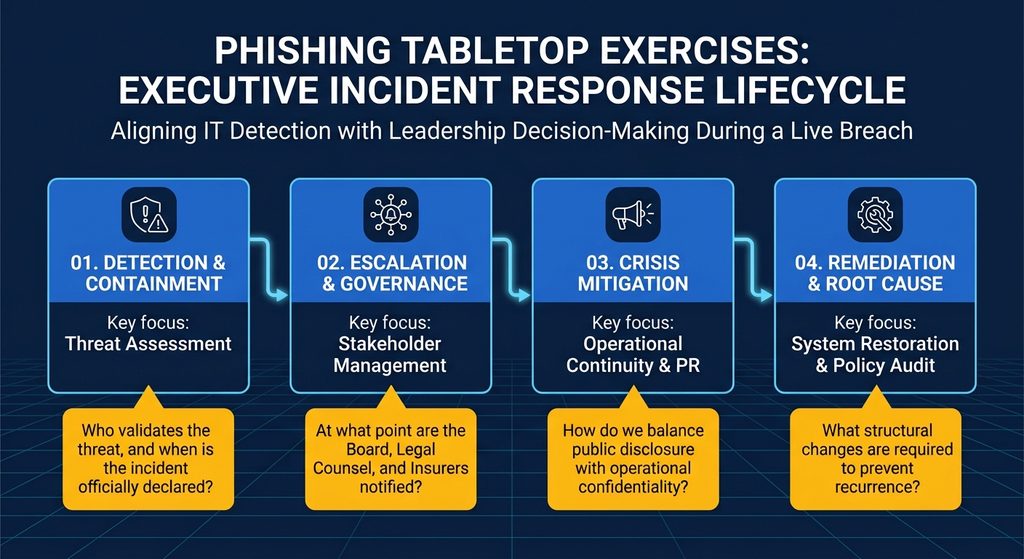
This operational framework highlights the transition from technical detection to strategic crisis management, ensuring that technical metrics line up with high-level business risks.
Breaking Down Silos Across Leadership
During a security incident, technical solutions only solve half the problem; organizational alignment solves the other half.
IT and Security Leadership
Your CISO and IT directors must translate complex technical data into clear risk metrics that non-technical executives can evaluate instantly. The exercise tests whether IT can communicate severity without drowning leadership in technical jargon.
Legal and Compliance Counsel
Legal teams must evaluate regulatory notification windows (such as GDPR or SEC reporting requirements) against incomplete forensic data. Practicing this balancing act prevents premature reporting or costly compliance delays.
Corporate Communications and PR
Public relations leaders must craft internal and external messaging that maintains stakeholder trust without compromising ongoing forensic investigations or violating legal advice.
Operationalizing Lessons Learned into Actionable Defense
Executing the exercise is only valuable if it leads to concrete improvements in your organization’s security posture.
1. Identify and Document Playbook Gaps
Immediately following the tabletop exercise, hold a structured debrief to identify where communication stalled or policies failed to provide clear direction. Update your Incident Response Plan to reflect these practical discoveries.
2. Standardize Out-of-Band Communication Channels
Real-world breaches often compromise primary email and messaging platforms. Ensure your management team has pre-configured, secure alternative communication tools to collaborate safely during an active incident.
3. Establish Clear Authorization Thresholds
Pre-determine who has the explicit authority to take critical systems offline, issue public statements, or retain external forensic firms. Clarifying these thresholds in advance eliminates hesitation during a crisis.
Building a Culture of Active Resilience
Security is not solely an IT responsibility; it is an enterprise risk management discipline that requires active, practiced leadership from the top.
By subjecting your management team to realistic phishing tabletop exercises, you transform passive policy guidelines into dynamic operational capability. When a real breach occurs, your team will rely on trained muscle memory rather than improvised reactions.