Executive Summary:
As quantum computing advances toward the capability to break foundational public-key cryptography (RSA and ECC), enterprise IT leaders must transition from static security architectures to crypto-agility. This long-term strategic shift requires mapping cryptographic assets, establishing modular, software-defined encryption layers, and adopting post-quantum cryptography (PQC) standards without disrupting live operations.
Key Takeaways:
- The Exposure Window: Data with a decade-long shelf life intercepted today via “harvest now, decrypt later” tactics is already compromised if your systems aren’t quantum-resistant.
- The Agility Mandate: Swapping encryption algorithms shouldn’t require a complete overhaul of your application stack; crypto-agility decouples underlying algorithms from core application logic.
- Actionable Roadmap: Discovery, abstraction, algorithmic testing, and automated lifecycle management form the core pillars of a resilient post-quantum posture.
The Silent Expiration Date on Enterprise Cryptography
Every piece of encrypted data moving across your network today carries an invisible expiration date. While standard AES-256 and RSA-2048 encryption feel immutable to contemporary computing power, the eventual arrival of cryptographically relevant quantum computers (CRQCs) will fundamentally dismantle the asymmetric cryptography that underpins secure web traffic, digital signatures, and identity governance.
The most immediate risk is not a future breach, but a current strategy known as “Harvest Now, Decrypt Later” (HNDL). Adversaries are intercepting and storing high-value, long-lifecycle enterprise data—intellectual property, strategic financial records, citizen data, and proprietary supply chain logistics—waiting for the hardware capable of breaking its key exchange mechanisms.
For mid-sized and enterprise organisations, the challenge isn’t merely adopting new Post-Quantum Cryptography (PQC) algorithms once they mature. The real bottleneck lies in hardcoded encryption, legacy protocols scattered across hybrid infrastructure, and application stacks where security mechanics are tightly coupled to logic. Moving to quantum resistance requires building a crypto-agile framework capable of replacing underlying algorithms seamlessly as standards evolve.
Deconstructing the Cryptographic Debt in Modern Infrastructure
To understand why transitioning to post-quantum standards presents such an operational hurdle, leadership must look at how cryptography was integrated into enterprise systems over the past two decades. Encryption was largely treated as a static utility—configured once, deployed deeply, and left untouched until a protocol was explicitly deprecated.
This mindset created deep cryptographic debt across three primary layers of the technology stack:
Hardcoded Logic and Monolithic Dependencies
In custom internal tools and enterprise applications, cryptographic operations are frequently written directly into source code using fixed library calls. Replacing a vulnerable algorithm in this environment requires code-level refactoring, extensive regression testing, and risky deployment cycles.
Embedded Hardware and Legacy Middleware
Hardware Security Modules (HSMs), load balancers, VPN gateways, and IoT edge devices often rely on fixed-function chips or obsolete firmware that cannot natively process the significantly larger key sizes and signature payloads required by post-quantum algorithms like ML-KEM or ML-DSA.
Fragmented Key Management
Decentralized teams often manage keys, certificates, and TLS endpoints in siloes. Without a unified inventory, security leaders lack visibility into where public-key cryptography is deployed, making targeted, phased algorithm migrations nearly impossible.
Structuring the Architectural Shift: The Crypto-Agility Stack
Building crypto-agility into an enterprise architecture means establishing a layer of abstraction between application code and the underlying cryptographic providers. When an algorithm needs to be updated, rotated, or replaced due to emerging vulnerabilities, the change should occur at the provider level without breaking application contracts. The blueprint below outlines how a crypto-agile architecture decouples application services from underlying algorithms, routing requests through an abstraction gateway to quantum-safe hardware and software modules.
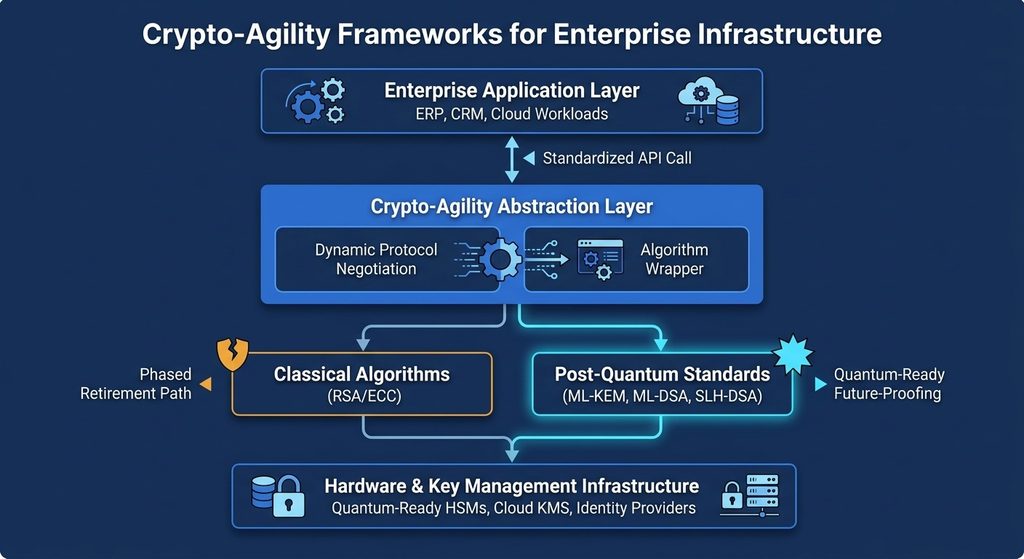
This operational flow ensures that applications communicate exclusively with an abstraction interface. The interface dynamically handles algorithm selection based on policy rules, active session contexts, and partner capabilities. This allows your organization to test PQC protocols in parallel with legacy standards without rewriting business logic.
Strategic Phases for Long-Term Post-Quantum Readiness
Transitioning an enterprise infrastructure to a post-quantum posture is a multi-year effort that must be integrated into your broader technology roadmap. Leaders can break this transformation into four structured phases:
Phase 1: Cryptographic Discovery and Automated Inventory
You cannot protect what you cannot locate. The initial step requires deploying automated discovery tools across public cloud environments, private data centers, API endpoints, and CI/CD pipelines to catalog every certificate, public key, symmetric key, and encryption library currently in use.
Key Diagnostic Question for Leadership: Do we maintain an automated, real-time Cryptographic Bill of Materials (CBOM) across our entire operational footprint?
Phase 2: Abstraction and API Standardization
Once assets are mapped, engineering teams should begin wrapping cryptographic calls inside modular APIs or service meshes. By centralizing key generation, signature verification, and payload encryption into dedicated security services, individual application teams no longer select or manage algorithms directly.
Key Implementation Step: Standardize internal developer portals on libraries that explicitly isolate cryptographic parameters into configuration files rather than functional code.
Phase 3: Hybrid Implementation and Algorithm Interoperability
Post-quantum algorithms require significantly larger key sizes and processing overhead than classical RSA. Enterprise networks must run hybrid schemes—combining a classical algorithm with a post-quantum candidate in a single handshake—to maintain baseline compliance while testing latency, packet fragmentation, and compute consumption.
Operational Risk to Monitor: Ensure that edge proxies and firewalls do not inadvertently drop hybrid TLS handshakes due to unexpected payload sizes.
Phase 4: Lifecycle Automation and Continuous Governance
Crypto-agility is an ongoing operational capability, not a one-time migration. Modern infrastructures must incorporate automated certificate lifecycle management (CLM) to handle rapid key rotations and algorithm deprecations as standards bodies update recommendations over time.
Actionable Next Steps for Technology Leadership
Navigating this architectural shift requires aligning executive sponsors, security engineering, and enterprise architects around a shared roadmap. To begin transforming your organization’s security posture today, consider the following tactical measures:
Establish a Cryptographic Bill of Materials (CBOM) Initiate an enterprise-wide discovery project to identify high-value data repositories protected by legacy public-key algorithms, specifically targeting data with long retention requirements.
Evaluate Vendor Post-Quantum Roadmaps Audit third-party SaaS, COTS software, and infrastructure providers. Require concrete timelines for their support of post-quantum standards, certificate rotation, and API abstraction.
Audit Hardware Capacity for Hybrid Handshakes Review network devices, load balancers, and Hardware Security Modules to verify whether existing hardware can support PQC key lengths via firmware updates, or if hardware refresh cycles must be accelerated.
Establish Internal Agility Guidelines for Developers Update software engineering policies to forbid hardcoded algorithm selections in new applications, mandating the use of centralized cryptographic helper libraries.
Rebuilding Trust for the Quantum Era
The transition to post-quantum security isn’t just about replacing math; it’s about altering how enterprises manage trust across their digital ecosystems. By shifting from static cryptographic configurations to modular, automated frameworks, organizations shield themselves against future algorithmic breakthroughs while streamlining their day-to-day security operations. The work required to secure your data against the quantum horizon starts long before the hardware arrives—it begins with the architectural decisions you make for your current technology stack.