
Every major enterprise compliance audit eventually uncovers a hidden ticking time bomb: a critical line-of-business application running on an out-of-warranty, legacy operating system. While keeping aging infrastructure on life support might look like a cost-conscious decision on a short-term P&L, it introduces compounding regulatory penalties, untrackable data breaches, and severe operational vulnerability.
Modern compliance frameworks no longer view operating system lifecycle management as a routine IT maintenance task. Instead, regulators treat unpatched and unsupported operating systems as a direct failure of executive risk management.
Key Executive Takeaways
- The Illusion of Cost Savings: Delaying OS migration creates exponential liability through uninsurable security incidents, regulatory fines, and emergency migration costs.
- Regulatory Deadlines Don’t Stretch: Frameworks such as HIPAA, PCI DSS 4.0, SOC 2, and GDPR explicitly demand vendor-supported software environments with active security updates.
- Insurance Negligence Defenses: Cyber insurance carriers increasingly deny claims outright when breaches trace back to unsupported, out-of-warranty operating systems.
- Strategy Over Patching: Mitigating legacy liabilities requires an executive strategy that balances legacy refactoring, platform isolation, and structured modernizations.
The Hidden Cost of “If It Isn’t Broken, Don’t Fix It”
In boardrooms across every industry, a quiet conflict plays out between operational continuity and risk mitigation. Legacy operating systems often power mission-critical workloads—from custom ERPs to specialized manufacturing control panels—that have operated reliably for a decade or more.
Because the software functions without daily failure, leadership often adopts a passive stance. The prevailing logic assumes that as long as the application delivers business output, the underlying operating system remains adequate.
This operational complacency creates a major strategic disconnect. Software vendors establish end-of-life (EOL) and end-of-warranty dates not to force hardware upgrades, but because underlying software architectures cannot indefinitely adapt to modern threat profiles.
When a vendor withdraws support, zero-day vulnerabilities remain unpatched permanently. At that exact moment, an asset shifts from an operational workhorse to a catastrophic compliance liability.
Anatomy of a Compliance Breakdown
Understanding how an out-of-warranty operating system degrades an enterprise compliance posture requires examining the intersection of modern regulatory mandates and technical obsolescence.
Unpatchable Vulnerabilities and the Threat Surface
Modern security governance relies on continuous vulnerability management. When an operating system moves past its warranty and vendor support window, the software engineering team behind it stops authoring and distributing security patches.
| [Legacy OS Platform] —> [Discontinued Vendor Patches] —> [Zero-Day Exposure] —> [Compliance Audit Failure] |
Attackers actively target known legacy vulnerabilities because the exploit scripts are publicly available and guaranteed to succeed against unpatched systems. Relying on network perimeter defenses to shield these systems creates a false sense of security that modern auditor frameworks explicitly reject.
The Mandate of Modern Regulatory Frameworks
Regulatory and industry standards have evolved from vague guidelines into prescriptive technical mandates. Running an out-of-warranty operating system directly violates the core tenets of major global standards:
- PCI DSS 4.0: Mandates that all system components are protected from known vulnerabilities by installing applicable vendor-supplied security patches. Out-of-warranty systems cannot receive these patches, resulting in immediate non-compliance for payment processing environments.
- HIPAA Security Rule: Requires covered entities to implement hardware, software, and procedural mechanisms that record and examine activity in systems containing ePHI. Unsupported operating systems lack modern audit logging integrations, creating explicit compliance gaps.
- SOC 2 Type II: Demands proof of proactive risk management and system maintenance. Auditors consistently flag out-of-warranty operating systems as unmitigated high-risk exceptions.
GDPR & Regional Privacy Laws: Require technical measures ensuring a level of security appropriate to the risk. Operating software with known, unfixable security flaws fails the “state of the art” technical standard required to safeguard personal data.
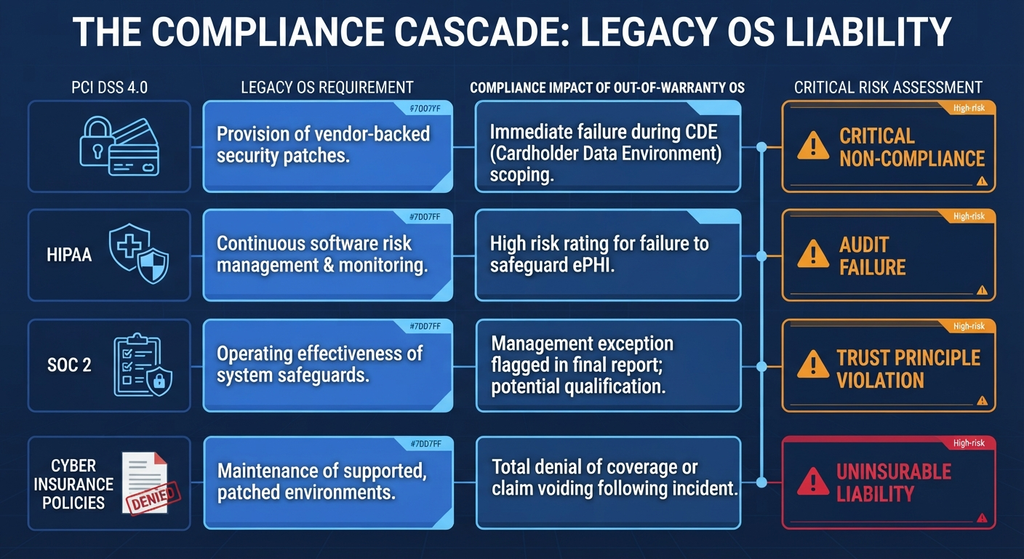
The summary comparison above underscores a simple truth: compliance frameworks do not grade on a curve for legacy operational dependencies. Non-compliance in a single system can compromise the regulatory status of the entire organization.
The Cascade Effect: Insurance Denial and Third-Party Risk
The financial ramifications of running out-of-warranty software extend far beyond statutory regulatory fines. The broader corporate ecosystem actively penalizes organizations that maintain legacy infrastructure liabilities.
Cyber Insurance Uninsurability
Cyber insurance underwriters have transformed from lenient risk-absorbers into rigorous controls auditors. Application questionnaires now ask explicit questions regarding the presence of end-of-life or out-of-warranty operating systems across the environment.
Misrepresenting the state of your operating systems on these declarations constitutes insurance fraud. Conversely, accurately reporting out-of-warranty systems typically results in explicit coverage exclusions, inflated deductibles, or outright refusal to issue a policy.
If a breach originates from an unsupported legacy OS, carriers routinely deny claims, leaving the enterprise to absorb all forensics, remediation, and legal liability costs directly.
Enterprise Supply Chain Mandates
B2B enterprises face increasing scrutiny from corporate clients during vendor risk assessments. Modern enterprise procurement teams require vendor security assessments (VSA) before awarding contracts.
When enterprise clients discover that their data will transit or reside on systems backed by out-of-warranty software, they frequently disqualify the vendor. In this way, legacy OS liability directly restricts top-line revenue growth and customer retention.
Strategic Remediation: Eliminating Legacy Operating System Liability
Resolving out-of-warranty OS risks requires a structured enterprise plan that balances technical realities with business continuity constraints.
1. Execute an Infrastructure Lifecycle Audit
Organizations cannot manage what they do not measure. Establish an immediate discovery phase across all hybrid environments to catalog every operating system instance, its current warranty status, and its application dependencies.
- Map every legacy operating system to its underlying business process and data classification.
- Identify applications that are hardcoded to legacy OS versions.
- Document current exposure levels to third-party networks and internal subnetworks.
2. Implement Immediate Risk Containment (Microsegmentation)
If an out-of-warranty system cannot be immediately upgraded or replaced, it must be isolated from the broader network environment to limit blast radius.
| [Production Network] — (Firewall / Zero-Trust Gateway) —> [Isolated Legacy Segment] —> [Out-of-Warranty OS] |
Establish strict zero-trust network access (ZTNA) policies around legacy assets. Restrict internet access entirely and limit internal connectivity strictly to essential IP addresses and ports required for basic functionality.
3. Establish a Tiered Modernization Roadmap
Avoid viewing legacy migration as a single massive overhaul. Categorize legacy workloads into clear strategic pathways:
- Rehost (Lift and Shift): Migrate the legacy workload into a cloud environment with extended security update (ESU) support agreements where available.
- Refactor / Replatform: Containerize application logic or rewrite core modules to run on modern, fully supported distributions.
- Replace (SaaS Transition): Transition legacy on-premises software functionality to a modern software-as-a-service alternative.
- Retire: Decommission redundant legacy systems whose underlying business processes are no longer essential.

Reclaiming Governance Over Your Infrastructure
Running out-of-warranty operating systems is a high-stakes gamble that exchanges temporary operational convenience for systemic enterprise risk. Modern compliance frameworks, cyber insurance providers, and enterprise buyers no longer tolerate unpatched infrastructure liabilities.
By treating OS lifecycle management as an essential component of corporate governance, business leaders protect their organizations from catastrophic breaches, preserve audit integrity, and build a resilient foundation for long-term digital growth.