Executive Summary:
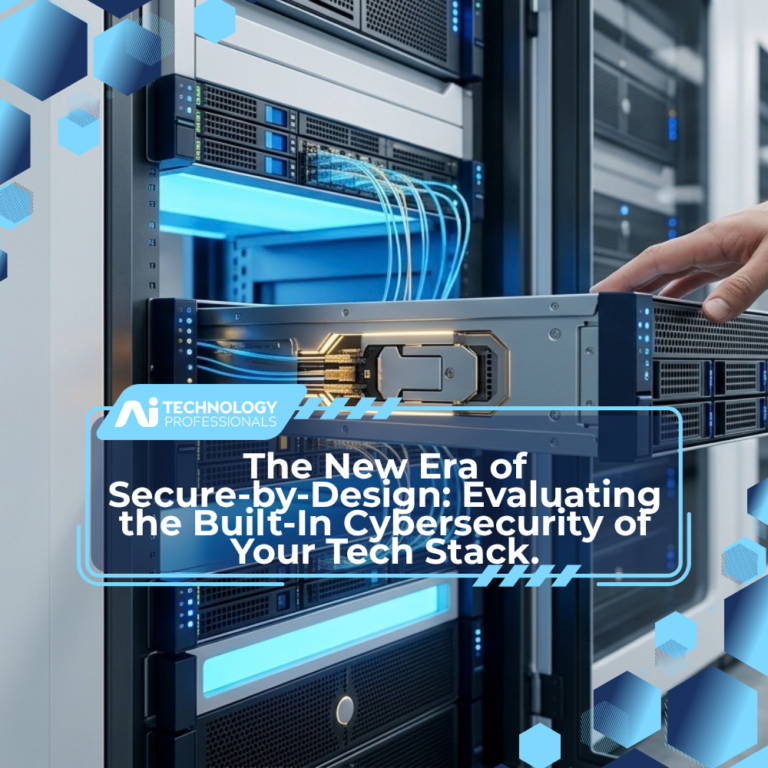
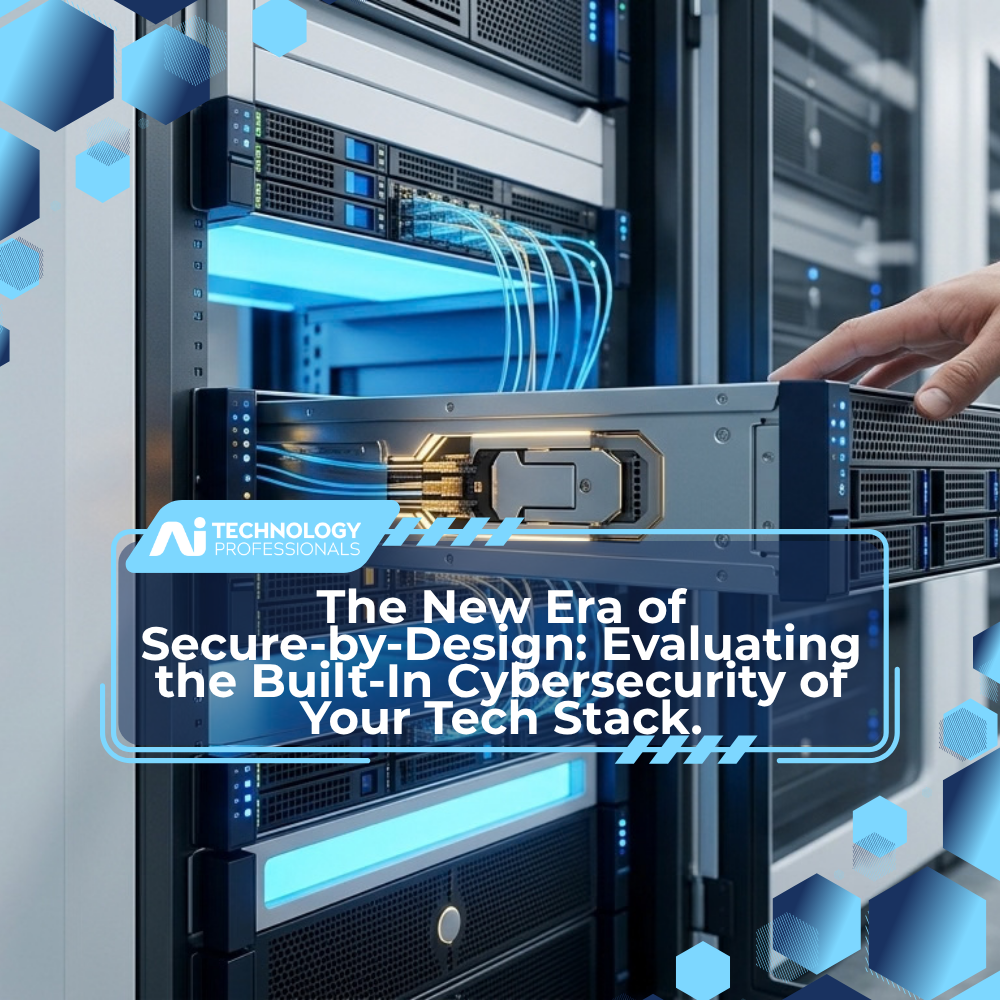
Security can no longer exist as a bolt-on solution or an after-the-fact operational tax. As modern enterprise architectures scale in complexity, retrofitting protection onto inherently fragile software creates unmanageable attack surfaces and exponential maintenance costs. Adopting a Secure-by-Design methodology shifts the responsibility from perpetual operational firefighting to fundamental architectural integrity.
Key Takeaways for Enterprise Leadership:
- Intrinsic vs. Extrinsic Security: Legacy approaches rely on surrounding vulnerable code with external security tools; Secure-by-Design bakes resilience directly into the core code and platform architecture.
- The Financial Pivot: Shifting security evaluation to the procurement and design phase slashes long-term technical debt and drastically lowers incident remediation costs.
- Tech Stack Auditability: Executive leaders must continuously audit vendors on memory safety, default configuration posture, and transparent vulnerability disclosure practices.
- Operational Velocity: Systems built securely at the foundational level empower development and operations teams to ship features faster without triggering compliance roadblocks.
The Dangerous Illusion of Perimeter Defense in Modern Enterprise IT
For over two decades, enterprise technology strategy operated on a simple, comfortable premise: build or buy the software that drives the business, and wrap it in layers of perimeter defenses. Firewalls, endpoint detection agents, and intrusion protection systems were deployed like castle moats to keep adversaries at bay.
That paradigm is officially broken. The expansion of cloud-native infrastructure, hybrid workforces, and complex API ecosystems has completely dissolved the traditional network perimeter. Today, enterprise stacks are interconnected webs of third-party software, microservices, and SaaS platforms, where a single weak link compromises the entire chain.
Despite record spending on security tools, high-profile breaches continue to escalate because organizations are attempting to secure systems that were fundamentally built without security in mind. Expecting operations teams to secure inherently insecure software with add-on tools is a losing strategy that guarantees systemic fatigue and eventual failure.
Deconstructing Secure-by-Design: Architectural Intrinsic Security vs. Reactive Patching
Secure-by-Design is not a marketing catchphrase or a compliance checkbox; it is a fundamental shift in engineering philosophy and vendor selection. It demands that software products are architected, developed, and delivered in a manner that significantly reduces the probability and impact of security vulnerabilities before they ever hit production. When you evaluate software under this paradigm, you stop asking “What security features does this product offer?” and start asking “How was this product built, and how does it behave out of the box?”
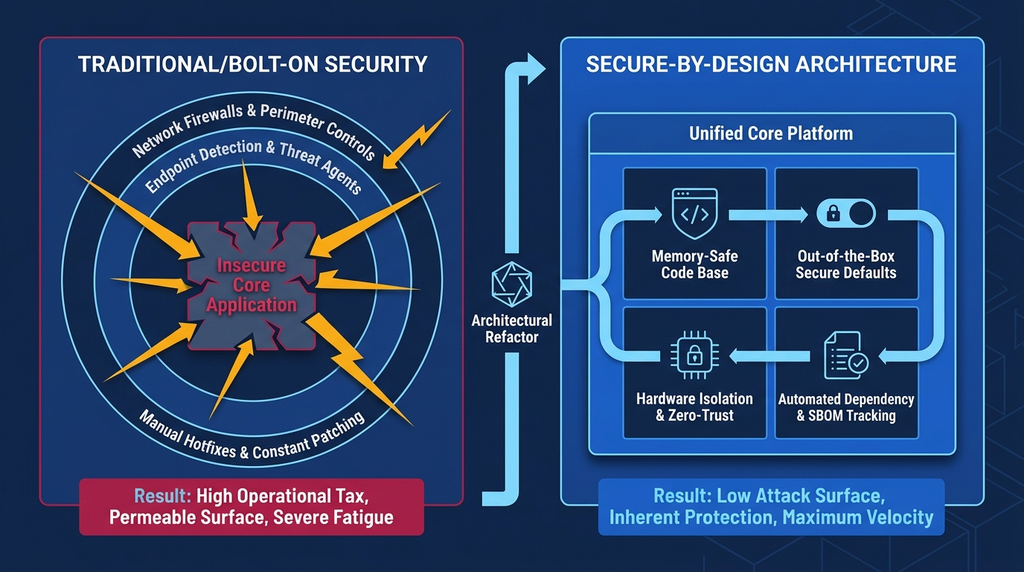
The core contrast comes down to operational overhead versus inherent resilience. Traditional bolt-on models force your internal team to configure dozens of protective policies, manage aggressive patch schedules, and constantly monitor for structural flaws that should never have existed in the first place. A true Secure-by-Design platform absorbs those burdens at the foundational level.
1. Eliminating Vulnerability Classes at the Source
Rather than playing an endless game of whack-a-mole with individual software bugs, Secure-by-Design focuses on eliminating entire classes of vulnerabilities. This includes transitioning critical codebases to memory-safe programming languages, utilizing parameterized queries by default to eliminate injection attacks, and enforcing strict type safety across internal interfaces.
2. The Power of Secure-by-Default Configurations
A product built on secure principles does not ship with default administrative passwords, permissive API access, or unencrypted data channels. Out-of-the-box configurations must mandate the highest security state possible without requiring extensive, error-prone manual setup by system administrators.
3. Radical Transparency and Threat Modeling
Secure-by-Design vendors openly publish their architectural threat models, memory-safety transition roadmaps, and detailed root-cause analyses when vulnerabilities occur. Transparency is the ultimate stress test of foundational security maturity.
Strategic Framework: How to Audit the Built-In Resilience of Your Existing Stack
Evaluating your current and prospective technology stack through a Secure-by-Design lens requires shifting focus from surface-level features to structural design patterns. Business and technical leadership must collaborate to conduct systematic evaluations across four critical dimensions.
Dimension 1: Memory Safety and Code Foundations
Inquire directly with your software suppliers regarding their underlying programming frameworks and modern code hygiene. Legacy platforms heavily reliant on memory-unsafe languages without strict safety guards pose a perpetual risk of remote code execution exploits that no external agent can fully mitigate.
Dimension 2: Identity, Access, and Least Privilege Integration
Assess how deeply identity controls are woven into the product architecture. Does the platform support native granular Access Control Lists (ACLs), passwordless standards, and automated token rotation without requiring costly add-on modules or complex custom scripts?
Dimension 3: Automated Dependency Management
Modern platforms rely heavily on open-source libraries and third-party software components. Evaluate whether your vendors utilize automated, continuous Software Bill of Materials (SBOM) tracking to identify and remediate upstream dependency risks before they manifest in your environment.
Dimension 4: Telemetry, Observability, and Auditability
Security cannot be evaluated if system behavior is invisible. Ensure that every platform in your stack generates immutable, high-fidelity security logs out of the box, with standardized export capabilities to your central observability tools.
Actionable Steps for Enterprise Leaders to Drive Security Transformation
Transforming your technology organization from a reactive security stance to an intrinsically secure model requires clear executive leadership, rigorous procurement policies, and strategic vendor alignment.
Step 1: Overhaul Procurement and RFP Criteria
Update your vendor procurement processes immediately to demand explicit answers regarding Secure-by-Design practices. Require vendors to detail their secure software development lifecycles (SSDLC), default security postures, and history of proactive vulnerability disclosures before signing renewal or purchase contracts.
Step 2: Establish a Tech Stack Rationalization Plan
Conduct a comprehensive inventory of your active applications and cloud infrastructure. Identify legacy systems that require constant, complex patching and external wraparound controls to remain compliant, and map out a phased plan to refactor or retire them in favor of inherently secure platforms.
Step 3: Shift Security Metrics to Root-Cause Reduction
Move your internal reporting away from vanity metrics like “number of patches applied” or “volume of blocked alerts.” Focus instead on structural indicators, such as the reduction of high-severity vulnerability classes in production, the percentage of applications using secure defaults, and time-to-remediation for architectural technical debt.
Grounding Your Future Architecture in Intrinsic Resilience
The historical practice of buying feature-rich software today and worrying about how to secure it tomorrow is no longer viable for modern enterprises. As cyber threats become more sophisticated and operationally disruptive, the market will increasingly reward organizations that prioritize structural integrity over superficial functionality.
By insisting on Secure-by-Design principles across your internal development teams and external vendor relationships, you protect your enterprise from catastrophic exposure while significantly lowering the long-term operational costs of cybersecurity. Inherent security is not a barrier to business velocity—it is the foundation that makes sustained digital innovation possible.