Executive Summary
The traditional corporate network perimeter is dead. As hybrid workers access decentralized applications from corporate offices, home networks, and coffee shops, data is increasingly processed at the “edge” of your network. Securely managing this highly distributed compute landscape requires shifting from a centralized castle-and-moat security model to an agile, identity-centric Edge Security framework. By embedding security directly into your distributed endpoints and network edge, mid-sized organizations can protect critical assets without compromising user productivity.
The Hybrid Disconnect: A Perimeter Without Walls
For decades, securing a mid-sized business followed a predictable playbook. You built a strong firewall around your primary office, funneled all traffic through it, and trusted everything inside the perimeter.
Today, that playbook is a liability. Your employees are everywhere, and so is your data.
A hybrid accountant might start their morning running complex data analytics on a local edge device at home, answer emails via a public Wi-Fi network at lunch, and plug into a conference room desk in the afternoon. The data isn’t waiting to be checked at the corporate data center; it is being generated, processed, and stored across a sprawling web of distributed compute networks.
This shift has created a dangerous strategic gap. While your workforce has become highly distributed and agile, your security infrastructure might still be trying to anchor them to a central location.
When hybrid workers are forced to route their traffic back through a legacy corporate VPN, it creates massive latency bottlenecks. Employees get frustrated, performance suffers, and—worst of all—they find insecure workarounds to get their jobs done.
The Physics of the Modern Edge: Why Traditional IT is Faltering
To understand why this technical challenge is so persistent, we have to look at where data processing actually happens today. We are no longer just dealing with “remote access.” We are dealing with localized, distributed compute power.
The Compute Drift
Applications have migrated to the cloud, but computing power has pushed outward to the edge. Micro-offices, IoT devices, and high-performance hybrid laptops are now processing data locally to ensure real-time responsiveness. This means the attack surface isn’t just larger—it is constantly changing shape.
The Visibility Eclipse
When data is processed across dozens of distributed office nodes and home environments, central IT teams lose visibility. You cannot protect what you cannot see. If an edge device in a hybrid worker’s home office is compromised, a legacy network often lacks the micro-segmentation required to stop that threat from laterally moving into the core corporate infrastructure.
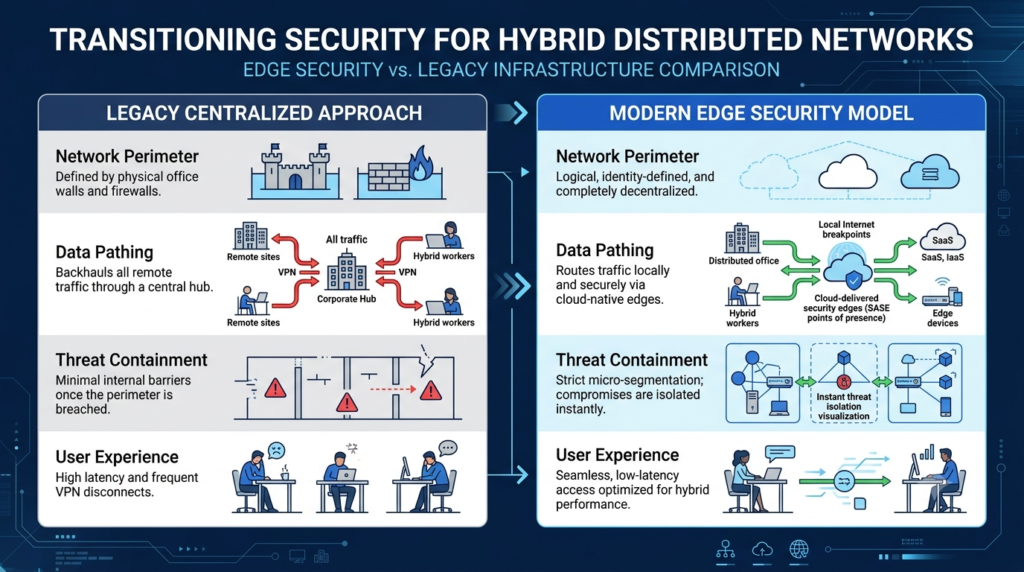
Mapping the Architecture: Edge Security vs. Legacy Infrastructure
To successfully protect a distributed compute network, leadership teams must understand the architectural shift required to keep pace with a hybrid workforce.
| Security Metric | Legacy Centralized Approach | Modern Edge Security Model |
| Network Perimeter | Defined by physical office walls and firewalls. | Logical, identity-defined, and completely decentralized. |
| Data Pathing | Backhauls all remote traffic through a central hub. | Routes traffic locally and securely via cloud-native edges. |
| Threat Containment | Minimal internal barriers once the perimeter is breached. | Strict micro-segmentation; compromises are isolated instantly. |
| User Experience | High latency and frequent VPN disconnects. | Seamless, low-latency access optimized for hybrid performance. |
The breakdown above highlights how the fundamental mechanics of data protection have shifted. Traditional systems rely on location, while modern edge security relies entirely on context and identity.
A Blueprint for Securing Your Distributed Nodes
Transitioning to a secure edge framework doesn’t require a complete rip-and-replace of your existing IT investments. Instead, it requires a strategic realignment of how access and computing power are managed.
1. Implement Identity as the New Perimeter
Stop trusting devices based on their physical location or IP address. Transition your hybrid workforce toward a Zero Trust Network Access (ZTNA) model, where every user and device must be continuously verified and authenticated, regardless of whether they are sitting in the main headquarters or a home kitchen.
2. Deploy Secure Access Service Edge (SASE)
Consolidate your networking and security functions into a single, cloud-delivered service. SASE combines software-defined networking (SD-WAN) with comprehensive security layer tools, allowing you to apply consistent security policies to all distributed compute nodes seamlessly.
3. Enforce Edge Micro-Segmentation
Isolate your network endpoints so that they cannot communicate with each other unless explicitly authorized. If a hybrid worker’s laptop catches malware on an unsecure network, micro-segmentation ensures the threat remains isolated to that single edge node, saving the rest of your business from downtime.
4. Optimize Localized Threat Detection
Equip your distributed endpoints with Endpoint Detection and Response (EDR) tools that leverage localized machine learning. These tools can identify and neutralize suspicious behavioral patterns right at the edge, even if the device is temporarily offline or disconnected from the central corporate network.
Balancing Frictionless Access with Uncompromising Protection
Securing a mid-sized organization is ultimately an exercise in balance. If your security measures are too restrictive, your hybrid culture will push back, resulting in shadow IT and operational inefficiencies. If your measures are too loose, you invite catastrophic breach risks.
Edge security solves this dilemma by moving the protection closer to where the work actually happens. It acknowledges that your offices are no longer just buildings—they are dynamic nodes in a global network.
By protecting the distributed compute networks that power your hybrid workers, you aren’t just managing risk. You are building a resilient, high-performance foundation for the future of your business.
The Leadership Takeaway
Strategic Directive: True operational resilience belongs to businesses that accept their network has no boundaries. Secure the worker, secure the endpoint, and secure the edge. As you look at your current IT roadmap and evaluate your support for a fluid, hybrid workforce, ask yourself this critical question: